


ULAANBAATAR, MONGOLIA (30 September 2025) — Mongolia’s economic growth is expected to be driven this year by a recovery in livestock numbers and the ramp-up of the Oyu Tolgoi underground mine. However, weaker coal exports and reduced government spending have led the Asian Development Bank (ADB) to lower its growth forecast.
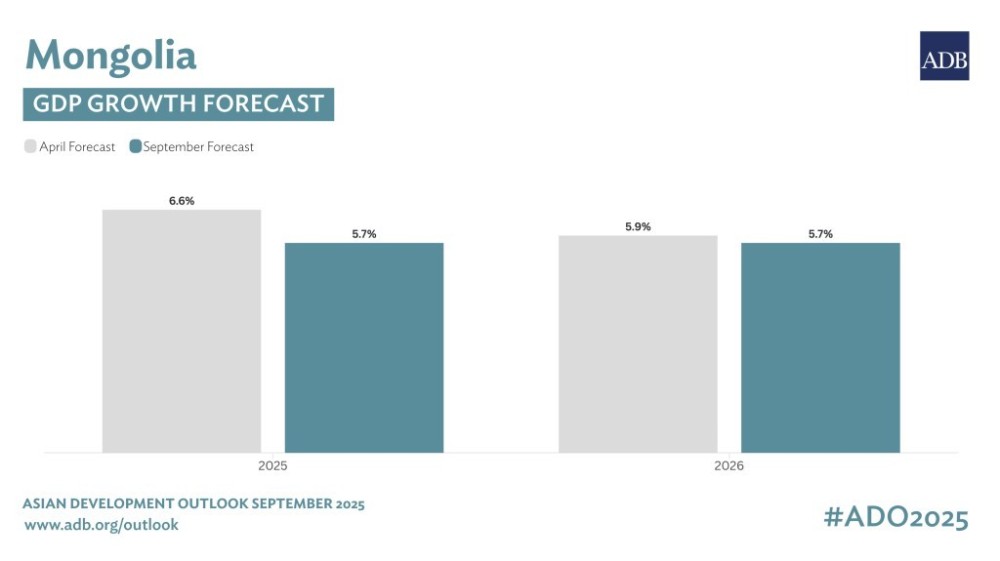
According to the Asian Development Outlook (ADO) September 2025 report, ADB projects Mongolia’s economic growth at 5.7% in both 2025 and 2026, down from April’s forecasts of 6.6% and 5.9%, respectively. Demand for Mongolia’s export minerals, especially coking coal, is expected to remain weak in 2025–2026 due to higher tariffs and trade restrictions affecting steel production in the People’s Republic of China (PRC). In addition, recent government spending cuts are likely to dampen consumption and public investment for the rest of 2025.
“Despite heightened global uncertainties, economic growth in Mongolia remains robust,” said ADB Country Director for Mongolia Shannon Cowlin. “It is now even more critical to foster broad-based and diversified growth, while addressing vulnerabilities linked to mineral dependence and commodity market volatility.”
Mongolia’s economic growth remained robust in the first half of 2025, largely driven by a recovery in herd size under favorable weather conditions.
Mining contributed less, as momentum in coal exports slowed amid weakening market conditions, while non-mining industries benefited from expansion in energy and construction. For the remainder of 2025, growth will be supported by non-mining industries and the services sector, although the expected drop in crop harvests may impact agriculture's recovery. Growth in 2026 is projected at 5.7%, led by services, while mining may underperform earlier expectations.
Inflation remained above the central bank’s target range in the first half of 2025 due to lingering effects from regulated price hikes. Consumer prices are forecast to rise by 8.6% this year, slightly below April’s projection of 9.1%, following updates to the consumption basket. The postponement of utility tariff increases is expected to delay additional price pressures until next year. As a result, inflation for 2026 is now projected at 7.2%. Price pressures remain elevated for domestic food and imported goods.
Risks to the outlook include further restrictions on the PRC’s steel production that could hurt demand for Mongolia’s exports, delays in the Oyu Tolgoi mine’s development, and the possibility of a harsh winter in 2025–2026 affecting agricultural production.
ADB is a leading multilateral development bank supporting inclusive, resilient, and sustainable growth across Asia and the Pacific. Working with its members and partners to solve complex challenges together, ADB harnesses innovative financial tools and strategic partnerships to transform lives, build quality infrastructure, and safeguard our planet. Founded in 1966, ADB is owned by 69 members—50 from the region.
ULAANBAATAR, MONGOLIA (30 September 2025) — Mongolia’s economic growth is expected to be driven this year by a recovery in livestock numbers and the ramp-up of the Oyu Tolgoi underground mine. However, weaker coal exports and reduced government spending have led the Asian Development Bank (ADB) to lower its growth forecast.
According to the Asian Development Outlook (ADO) September 2025 report, ADB projects Mongolia’s economic growth at 5.7% in both 2025 and 2026, down from April’s forecasts of 6.6% and 5.9%, respectively. Demand for Mongolia’s export minerals, especially coking coal, is expected to remain weak in 2025–2026 due to higher tariffs and trade restrictions affecting steel production in the People’s Republic of China (PRC). In addition, recent government spending cuts are likely to dampen consumption and public investment for the rest of 2025.
“Despite heightened global uncertainties, economic growth in Mongolia remains robust,” said ADB Country Director for Mongolia Shannon Cowlin. “It is now even more critical to foster broad-based and diversified growth, while addressing vulnerabilities linked to mineral dependence and commodity market volatility.”
Mongolia’s economic growth remained robust in the first half of 2025, largely driven by a recovery in herd size under favorable weather conditions.
Mining contributed less, as momentum in coal exports slowed amid weakening market conditions, while non-mining industries benefited from expansion in energy and construction. For the remainder of 2025, growth will be supported by non-mining industries and the services sector, although the expected drop in crop harvests may impact agriculture's recovery. Growth in 2026 is projected at 5.7%, led by services, while mining may underperform earlier expectations.
Inflation remained above the central bank’s target range in the first half of 2025 due to lingering effects from regulated price hikes. Consumer prices are forecast to rise by 8.6% this year, slightly below April’s projection of 9.1%, following updates to the consumption basket. The postponement of utility tariff increases is expected to delay additional price pressures until next year. As a result, inflation for 2026 is now projected at 7.2%. Price pressures remain elevated for domestic food and imported goods.
Risks to the outlook include further restrictions on the PRC’s steel production that could hurt demand for Mongolia’s exports, delays in the Oyu Tolgoi mine’s development, and the possibility of a harsh winter in 2025–2026 affecting agricultural production.
ADB is a leading multilateral development bank supporting inclusive, resilient, and sustainable growth across Asia and the Pacific. Working with its members and partners to solve complex challenges together, ADB harnesses innovative financial tools and strategic partnerships to transform lives, build quality infrastructure, and safeguard our planet. Founded in 1966, ADB is owned by 69 members—50 from the region.