



The most significant challenge facing Mongolia’s tourism sector is the inability to accurately calculate tourist numbers and their real economic impact. If we could precisely track domestic tourism data according to international standards, Mongolia would have the potential to climb at least 20 places in the Global Travel & Tourism Development Index. According to the latest report by the World Economic Forum, Mongolia currently ranks 85th out of 119 countries—a position directly linked to statistical ambiguity and the omission of domestic tourism data.
The Illusion of "One Million Tourists"
For years, sector ministers have annually announced the ambitious goal of "welcoming one million tourists," yet foreign tourism statistics remain questionable. Researchers emphasize a shift from "quantity to quality"—focusing on high-value tourists and economic yield—but these recommendations often fail to gain traction among policymakers. Currently, there is no integrated methodology to distinguish between genuine tourists and foreign laborers entering from Russia or China.
Furthermore, the number of Mongolians traveling abroad significantly exceeds the number of incoming tourists, creating a tourism trade deficit. This underscores the urgent need for policies that protect the local market and incentivize domestic tourism to keep capital circulating within the national economy.
The "Three Pillars" of Tourism
Theoretically, the tourism sector rests on three fundamental pillars:
1. Inbound Tourism: International travelers visiting Mongolia (Foreign currency inflow/Exports).
2. Outbound Tourism: Mongolian citizens traveling abroad (Foreign currency outflow/Imports).
3. Domestic & Internal Tourism: Citizens traveling within their own country (Economic resilience/Internal circulation).
By focusing solely on inbound numbers, we fail to calculate the sector's net economic effect. To achieve a balanced and profitable industry, domestic tourism must be supported as a strategic priority. In 2025, the National Statistics Office (NSO) conducted its first-ever domestic tourism sample survey involving 13,260 participants. The findings revealed:
- 3.2 million domestic trips (1.6 million unique travelers) were made in 2024.
- These trips generated an economic turnover of 3.2 trillion MNT.
Evidence-Based Research: The Onon-Balj Case Study
A study commissioned by WWF Mongolia proves that it is possible to track domestic travelers even at the smallest administrative level (soum). Led by Dr. B. Yerbakhyt of Otgontenger University, a team of scientists used mathematical modeling to calculate tourist flows into five soums witihin the Onon-Balj National Park: Binder, Bayan-Adarga, Dadal, Norovlin, and Bayan-Uul.
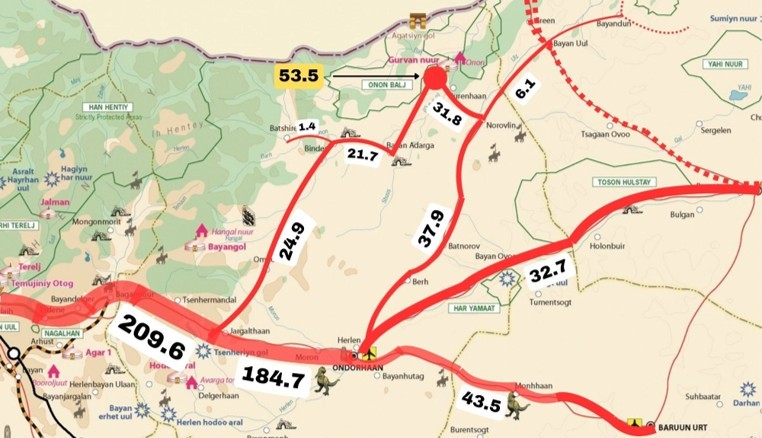
By analyzing traffic patterns through the Nalaikh-Terelj checkpoint, they found that 209.6 thousand passengers were tourists. The study mapped their movements:
- Binder: 24.9 thousand travelers via Jargaltkhaan.
- Dadal: 21.7 thousand via Bayan-Adarga and 37.9 thousand via Norovlin.
- Total for Dadal Soum: 53.5 thousand tourists per year, peaking with 16,000 in July and 14,000 in August.
Validating Numbers through Fuel Consumption
To verify these results, scientists employed an innovative method: Fuel-Based Calculation. By taking the total fuel sold in a soum and subtracting the estimated consumption of local vehicles (categorized by type and age), they identified "excess sales" attributable to tourists.
This calculation suggested that 316,000 tourists traveled within Khentii Province—a figure 2 to 2.5 times higher than the official NSO statistics. This indicates that current statistical methods likely significantly undervalue the actual market size.
Why Accurate Data Matters
- Accurate domestic data is the foundation for evidence-based management and opens several doors:
- Investment: Private investors and international organizations do not invest based on guesses. Concrete data builds the business confidence needed to develop hotels and resorts.
- Infrastructure & Carrying Capacity: Infrastructure (roads, power, waste management) is usually planned for local populations. However, during peak season, a soum’s "temporary" population can increase 10–20 times. Data allows for scientifically grounded infrastructure planning.
- Environmental Conservation: Every protected area has an ecological carrying capacity. Real-time monitoring allows managers to mitigate overcrowding and reroute flows to protect the environment.
- Local Economic Valuation: Uncovering "hidden" tourism revenue is vital for local budget planning and supporting SMEs and local craftsmanship.
The Solution: Leveraging Existing Digital Infrastructure
The research team suggests the most efficient solution lies in Mongolia’s roughly 40 Electronic Toll Collection (ETC) points. These points are already digitized, recognizing and recording every vehicle by its license plate.
- Real-time Database: By identifying vehicle registration codes, the system can instantly categorize "visitor flows" from other regions.
- Big Data Integration: Correlating ETC data with local fuel sales and hospitality revenue can provide a "soum-by-soum" economic impact report.
- Inter-Agency Cooperation: This requires the Ministry of Road and Transport, the Ministry of Tourism, and the NSO to integrate their data. This would create a high-accuracy system without the need for expensive new surveys.
Today, we possess the scientific solutions, the raw data, and the tested methodologies to transform Mongolia’s tourism sector. What remains absent at the decision-making level is the political will to turn this potential into reality.
While we chase the unattainable "One Million Tourists" myth, a 3.2 trillion MNT domestic market remains unmanaged, unplanned, and unsupported by infrastructure. This lack of coordination continues to drag down Mongolia’s global competitiveness. We do not need more slogans; we need the political courage to implement data-driven planning. If we cannot count, we cannot plan.
References:
- World Economic Forum. (2024). Travel & Tourism Development Index 2024.
- National Statistics Office of Mongolia. (2025). Domestic Tourism Sample Survey Results.
- WWF Mongolia. (2026). Development of Policy Recommendations with a Strategic Roadmap for Eco-Friendly and Sustainable Tourism in the Onon-Balj PA.
- WWF Mongolia. (2023). Tourism Impact Assessment Report on Onon-Balj PA.
- United Nations Tourism. (2008). International Recommendations for Tourism Statistics.
The most significant challenge facing Mongolia’s tourism sector is the inability to accurately calculate tourist numbers and their real economic impact. If we could precisely track domestic tourism data according to international standards, Mongolia would have the potential to climb at least 20 places in the Global Travel & Tourism Development Index. According to the latest report by the World Economic Forum, Mongolia currently ranks 85th out of 119 countries—a position directly linked to statistical ambiguity and the omission of domestic tourism data.
The Illusion of "One Million Tourists"
For years, sector ministers have annually announced the ambitious goal of "welcoming one million tourists," yet foreign tourism statistics remain questionable. Researchers emphasize a shift from "quantity to quality"—focusing on high-value tourists and economic yield—but these recommendations often fail to gain traction among policymakers. Currently, there is no integrated methodology to distinguish between genuine tourists and foreign laborers entering from Russia or China.
Furthermore, the number of Mongolians traveling abroad significantly exceeds the number of incoming tourists, creating a tourism trade deficit. This underscores the urgent need for policies that protect the local market and incentivize domestic tourism to keep capital circulating within the national economy.
The "Three Pillars" of Tourism
Theoretically, the tourism sector rests on three fundamental pillars:
1. Inbound Tourism: International travelers visiting Mongolia (Foreign currency inflow/Exports).
2. Outbound Tourism: Mongolian citizens traveling abroad (Foreign currency outflow/Imports).
3. Domestic & Internal Tourism: Citizens traveling within their own country (Economic resilience/Internal circulation).
By focusing solely on inbound numbers, we fail to calculate the sector's net economic effect. To achieve a balanced and profitable industry, domestic tourism must be supported as a strategic priority. In 2025, the National Statistics Office (NSO) conducted its first-ever domestic tourism sample survey involving 13,260 participants. The findings revealed:
- 3.2 million domestic trips (1.6 million unique travelers) were made in 2024.
- These trips generated an economic turnover of 3.2 trillion MNT.
Evidence-Based Research: The Onon-Balj Case Study
A study commissioned by WWF Mongolia proves that it is possible to track domestic travelers even at the smallest administrative level (soum). Led by Dr. B. Yerbakhyt of Otgontenger University, a team of scientists used mathematical modeling to calculate tourist flows into five soums witihin the Onon-Balj National Park: Binder, Bayan-Adarga, Dadal, Norovlin, and Bayan-Uul.
By analyzing traffic patterns through the Nalaikh-Terelj checkpoint, they found that 209.6 thousand passengers were tourists. The study mapped their movements:
- Binder: 24.9 thousand travelers via Jargaltkhaan.
- Dadal: 21.7 thousand via Bayan-Adarga and 37.9 thousand via Norovlin.
- Total for Dadal Soum: 53.5 thousand tourists per year, peaking with 16,000 in July and 14,000 in August.
Validating Numbers through Fuel Consumption
To verify these results, scientists employed an innovative method: Fuel-Based Calculation. By taking the total fuel sold in a soum and subtracting the estimated consumption of local vehicles (categorized by type and age), they identified "excess sales" attributable to tourists.
This calculation suggested that 316,000 tourists traveled within Khentii Province—a figure 2 to 2.5 times higher than the official NSO statistics. This indicates that current statistical methods likely significantly undervalue the actual market size.
Why Accurate Data Matters
- Accurate domestic data is the foundation for evidence-based management and opens several doors:
- Investment: Private investors and international organizations do not invest based on guesses. Concrete data builds the business confidence needed to develop hotels and resorts.
- Infrastructure & Carrying Capacity: Infrastructure (roads, power, waste management) is usually planned for local populations. However, during peak season, a soum’s "temporary" population can increase 10–20 times. Data allows for scientifically grounded infrastructure planning.
- Environmental Conservation: Every protected area has an ecological carrying capacity. Real-time monitoring allows managers to mitigate overcrowding and reroute flows to protect the environment.
- Local Economic Valuation: Uncovering "hidden" tourism revenue is vital for local budget planning and supporting SMEs and local craftsmanship.
The Solution: Leveraging Existing Digital Infrastructure
The research team suggests the most efficient solution lies in Mongolia’s roughly 40 Electronic Toll Collection (ETC) points. These points are already digitized, recognizing and recording every vehicle by its license plate.
- Real-time Database: By identifying vehicle registration codes, the system can instantly categorize "visitor flows" from other regions.
- Big Data Integration: Correlating ETC data with local fuel sales and hospitality revenue can provide a "soum-by-soum" economic impact report.
- Inter-Agency Cooperation: This requires the Ministry of Road and Transport, the Ministry of Tourism, and the NSO to integrate their data. This would create a high-accuracy system without the need for expensive new surveys.
Today, we possess the scientific solutions, the raw data, and the tested methodologies to transform Mongolia’s tourism sector. What remains absent at the decision-making level is the political will to turn this potential into reality.
While we chase the unattainable "One Million Tourists" myth, a 3.2 trillion MNT domestic market remains unmanaged, unplanned, and unsupported by infrastructure. This lack of coordination continues to drag down Mongolia’s global competitiveness. We do not need more slogans; we need the political courage to implement data-driven planning. If we cannot count, we cannot plan.
References:
- World Economic Forum. (2024). Travel & Tourism Development Index 2024.
- National Statistics Office of Mongolia. (2025). Domestic Tourism Sample Survey Results.
- WWF Mongolia. (2026). Development of Policy Recommendations with a Strategic Roadmap for Eco-Friendly and Sustainable Tourism in the Onon-Balj PA.
- WWF Mongolia. (2023). Tourism Impact Assessment Report on Onon-Balj PA.
- United Nations Tourism. (2008). International Recommendations for Tourism Statistics.