Why did you choose to publish Hyam Maccoby’s Jesus and the Jewish Resistance in Mongolia? What can it offer Mongolian readers?
It's, in a certain way, the same reason why I published the other book we were talking about three years ago.
The issue of religion is very important. We saw last time that the Vatican is a very strong organization, and that they try to convert Mongolians to Catholicism. I think Mongolians are intelligent enough not to be converted to anything.
I like Mongolians. We are here very often. My life partner is Mongolian. And I want to contribute to the weaponry of Mongolians to defend themselves against foreign influence. Their history also plays an important role. For example, the Vatican, which we were talking about last time, was very nearly affiliated with the emergence of fascism in Europe.
So, it's also a political force. It has a strong organization and a lot of money. And it tries to involve other people, not only Mongolians, in its way of thinking and in its religion. I think it's useful for any people, not only Mongolians, to know what Christianity and Catholicism mean, not only politically but also in terms of ideology. This is why I'm publishing these two books here.
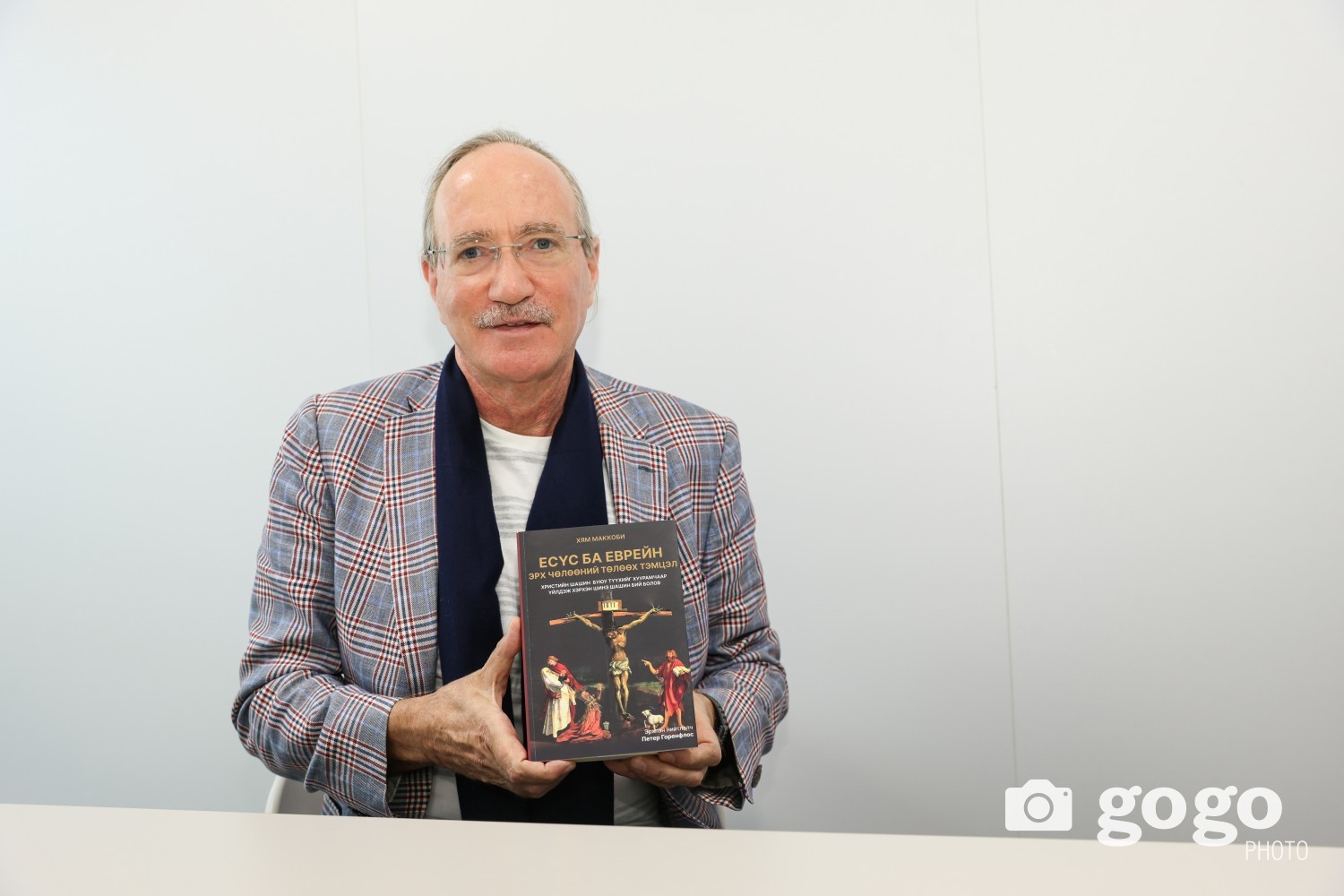
Please tell us more about the writer, Hyam Maccoby.
Hyam Maccoby lived from 1924 to 2004. He lived to the age of 80. He was a professor of Jewish studies in the United Kingdom.
He was also a librarian at Leo Baeck College in London. He was a historian of ancient history and religion, and he was also a Reform rabbi.
So, he was a religious person, but not only a religious person. He was Jewish. And it is my conviction that he was one of the best historians who researched the emergence of Christianity—how it developed, what it is about, and what its relationship to Judaism is. I think he was one of the best researchers and scholars on this subject. And he is not very well known in Europe.
He's well known in the United Kingdom and the U.S., but not on the continent. So, I'm publishing Maccoby in Germany with Hentrich&Hentrich. There are other publishing houses in Germany.
Ahriman is publishing Maccoby, too. I'm publishing him in Italy. It's very important because Italy is the country of Catholicism.
The Vatican State is in Italy. And now I'm publishing this book in Mongolia.
So, is this your second book in Mongolia?
Yes, it is. But it's the first book by Maccoby in Mongolia, and it's my second book here overall. The first book was written by Karlheinz Deschner, who explained the relationship between the Vatican and Hitler, Mussolini, Franco and Pavelić.
And this book goes much deeper into history, to the origins of Christianity—not how Christianity developed later and not what political function it had in the Middle Ages or in modern times.
In the Middle Ages, Catholicism was even stronger than today. The Inquisition killed opponents of Catholicism, and Christianity became a state religion in late antiquity under the Emperor Constantine.
It became a state religion, and then it became very strong. But this is not what this book is about. So, the last book was about the 20th century, the relationship between the Vatican and Christianity and fascism. And this one is about the origins of Christianity.
Why do you choose the subject of religion so often?
It's connected to religion, and this one is about the origins. Because the more you know, the better it is. There's a very long history—a 2,000-year history of Christianity. And it's not only worthwhile talking about current history or the last century.
If you want to defend yourself, if the Mongolian people want to defend themselves against foreign influences, it's important to know as much as possible. And you can't know everything, but I think knowledge of the history of the 20th century and knowledge of the origins of Christianity are very useful for understanding what kind of ideology you are dealing with when you live in Mongolia. That's what I wanted to say about why I'm doing this in Mongolia.
As we saw last time, the Pope came to Mongolia. So, they are trying to gain influence here. They are also trying to gain influence in China.
And this is not the first time that Catholicism has been present in Mongolia, but it's the first time that the Pope himself came. And as I've written in my foreword, already in the 13th century, the Pope had his envoy. It was John of Plano Carpini who came to the country.
He was an envoy, and he already wanted to convert the Mongolians to Catholicism in the 13th century. So, you see, there's a very long tradition. And the Mongolians in the 13th century, under Güyük Khan, were strong enough to say, “No, we do not accept this. You have to submit to the Khan, not the other way around.”
I think this was a very healthy reaction to what happened because, decades earlier, Genghis Khan, Ögedei Khan and Batu had conducted military campaigns against the West, and they went really very far—to Poland, Russia and Bulgaria. And if Ögedei Khan had not died in 1241, they would probably have gone further to Italy, and maybe history would have developed completely differently. Maybe the Pope would have been a prisoner of the Khan if Ögedei Khan had not died in 1241. So, all this history is really extremely interesting for us Europeans and for you Mongolians.
There was a deep influence. Russia was deeply influenced by the Mongolians, and large parts of Asia were deeply influenced by Genghis Khan and his sons and grandsons. So, the Mongolians went back to the Mongolian plateau, and then we had a new Pope in Europe, Innocent IV, and he sent envoys, including John of Plano Carpini, to find out who the Mongolians were and whether there was a possibility of converting them to Christianity. And then they were afraid.
They wanted to know whether other campaigns were planned to conquer Europe or not. There were also kings in Europe. For example, the French king, Louis IX, wanted to have the Mongolians as allies against the Muslims because he wanted to conquer Jerusalem. So, this whole history of the 13th century was very, very interesting, and the Mongolians played a very important role during this time—especially in the 13th century, and then less so in the 14th century.
All this is not what this book is about, but it's about history, and history is something very important. In the 13th century, Güyük Khan was strong enough to resist European influence. The Pope is coming again now, in 2023, and I want to provide information for Mongolians to defend themselves against this new attempt to gain influence in East Asia, in Mongolia and in China.
I think it's very useful to know and have an idea of the origins of Christianity. So, what we've just been talking about is not what this book is about, but it's important nevertheless.

And do you mean raising awareness about this issue and considering policies to address concerns related to this religion?
I don't want to influence anybody, but I would like to plead for independent nations, and I plead against imperialism. If a country sends its priests or its religion to another country, it's often the first step toward conquering the whole country and fulfilling one's imperialistic aims. So, it's important at the forefront of such developments to have antibodies and weapons, if you will, against such attempts to influence people.
And the problem is, I'm for freedom of religion. Everybody should think what they want and believe what they want. But the problem is that, for example, Korea sends evangelicals to Mongolia, and they do not just come to convert Mongolians.
They have strong organizations and lots of money. So, this is more than just an attempt to convert somebody. It's a strong political influence.
And what the evangelicals from Korea and other countries, including the U.S., are trying to do is the same as what the Vatican is doing. But the difference is that they are different branches of Christianity. The evangelicals are Protestants.
That's another denomination that developed about 500 years ago. And the Vatican is the representative of the original kind of Christianity, Catholicism. And then there were the Nestorians.
I've talked about this in my foreword. The Nestorians were here even much earlier. They came along the Silk Road or the trade routes and already had some influence, but not a very strong influence.
And there were no strong powers, strong organizations or financially powerful institutions behind this development. It was a spontaneous development. And it was not as dangerous as what we are seeing now.
The book argues that Christianity was founded by Paul rather than Jesus. What historical evidence supports this view?
There are different denominations and different branches of Christianity. But they all have the same conviction that Jesus was the founder of the religion. And this is wrong. Maccoby proves, and not only Maccoby but many others as well, that Christianity was not founded by Jesus.
Jesus was a Jew. He was a faithful Jew. He believed in the Torah, which is the legal code of Judaism. And it was not his conviction that a new religion should be founded.
So how can one know this? What knowledge is important to reach this conclusion?
Already in the Middle Ages, rabbis, the priests of Judaism, asked whether what was written in the New Testament was a true story or a fantasy story. And there have been many contradictions within the New Testament. Later, in the 19th century, German theologians also discussed this issue on a scientific basis.
There was the theologian Ferdinand Christian Baur. He was the head of the Tübingen School. And he used the tendency method to find out what the New Testament is about.
The tendency method means that you look at contradictions within the text. Then you can find out if there is a deeper layer beneath the original text, a deeper stratum that might contain the substance of an original history.
So, there was Julius Wellhausen in the 19th century, who came to the conclusion that Jesus could not have been Christ. Impossible. And then there was another theologian, Rudolf Bultmann. He said he was afraid that Christianity could no longer be taken seriously.
If Jesus is not the founder, it might be useless to spread Christianity. So, he said the historical Jesus is not important. What is important is the mythological Jesus.
But if this is true, as he postulated, then you could use any fairy tale as the basis of a religion. It's absurd. But it opened the way for a new school.
And this new school was called the Jewish View on Jesus. Hyam Maccoby is the most important representative of this school, the Jewish View on Jesus. And as a rabbi and professor of Judaism, he knew a great deal about Judaism.
He spoke Biblical Hebrew. He knew Aramaic, which was the original language in Palestine 2,000 years ago. He learned all those languages as a child from his grandfather.
So, he had a very precise view on this issue. I want just to mention some of those contradictions. Let's talk about the contradictions in the New Testament. There is, for example, one question. For Christians, the crucifixion of Jesus is the purpose of his life.
He has to be crucified for the salvation of the faithful, which is, in my eyes, a very, very cruel philosophy. It's a human sacrifice at the center of the religion. This is strange and cruel.
But the question is, if the crucifixion of Jesus was the purpose of his life, why did he preach for so many years? And what did he preach about? If the purpose of his life is his crucifixion, what could he have been preaching about? That suicide is important because it was his crucifixion, and that is what is important for the salvation of the faithful?
Or there are other questions. On Palm Sunday, Jesus rode on his donkey to Jerusalem.
And the whole population, the Jewish population, welcomed him fanatically as the new king, as the Messiah, as the person who would repel and expel the Romans who occupied Palestine, Judea, at that time. And five days later, on Good Friday, they demanded his death. This makes no sense.
Why, within five days, would they welcome him so enthusiastically and then demand his death when Pontius Pilate asked them whether he should be freed or not?
Or another example: Paul called himself, declared himself, a Pharisee of the Pharisees. So, he wanted to give himself a good reputation because the Pharisees were a very devout part of the Jewish community within Judea at this time. And the rabbis, the wise men in Judaism at this time, would all have been Pharisees. Pharisees were representatives of the people.
And the elite of the country were all Pharisees. So why did he call himself a Pharisee of the Pharisees and at the same time disavow the Pharisees? He denounced them as hypocrites; he denounced them as legalists. It makes no sense at all. And then there are other questions. For example, Judas, for Christians, is the betrayer of Jesus. He betrayed him to Rome so that he could be crucified.
But if the crucifixion is important for the salvation of Christians, why is he the bad guy? His betrayal of Jesus was the prerequisite for the salvation of the faithful. So why is he the bad guy?
And there are lots of other questions. For example, is it really true that the Passover privilege existed, under which the Jews had the right to free a prisoner? Why do the Romans play such a small role in the Gospels, although the main problem at this time was the Roman occupation?
There are many more of these questions that were asked by rabbis in the Middle Ages, and later by Julius Wellhausen, Ferdinand Baur, and Hyam Maccoby in the 19th and 20th centuries.
And I think it makes sense to talk about the conclusion of all these stories. And the conclusion is—and this can be proved very clearly in this book—that it was Paul who invented Christianity. He was not a Pharisee of the Pharisees, and he was not even Jewish at the beginning. He converted as a Greek to Judaism.
He lived in Asia Minor, which is in the Middle East—you would call it a region in what is now Turkey. He converted as an adult, and he was impressed by Judaism. So, he came to Jerusalem and tried to make his career there, but he was a latecomer.
It was too late. If you don't learn this religion from childhood, you can't become a rabbi. So, the conclusion of Hyam Maccoby is that he turned to the high priest, who was a Jew, but he was a betrayer.
He worked for the Romans. He came to the high priest, who was a police chief of the Romans, and worked for this police chief. The police chief pursued the followers of Jesus, who were called Nazarenes, probably because the hometown of Jesus was Nazareth.
But Paul himself didn't know Jesus because he came after the death of Jesus, after the crucifixion. He never knew Jesus in person. But on the way to Damascus, where he wanted to arrest Nazarene members, he had a kind of hallucination, a kind of revelation.
In other words, we have to talk about it later. He had a kind of revelation, and in this hallucination, Paul talked with Jesus, who had already died about 10 years earlier. In his mind, it was a psychopathological process.
It was a hallucination, a revelation. He talked with Jesus, and he concluded that Jesus was something like a God who was sacrificed for the faithful.

How did this come about?
Paul came from Tarsus, and the main religions in Tarsus were the Greek mystery cults.
In those mystery cults, a god was symbolically sacrificed for the sins of the faithful, and a god was sacrificed for eternal life. In former times, before those Greek mystery cults, there had been real human sacrifices in the Mediterranean area during the Neolithic period. There were real human sacrifices intended to avoid or overcome catastrophes—earthquakes, volcanic eruptions, floods, pandemics and famines caused by bad harvests.
They had such human sacrifices thousands of years ago, very, very cruelly, and this is a historical reality. They had them when they wanted to found a new city or establish a new tribe. So those human sacrifices became more sophisticated, and then only symbolically a god was sacrificed, rather than a human person. Later, an animal was sacrificed, but then, symbolically, a god was sacrificed for the sins of people.
And there were lots of such mystery cults in Asia Minor and in Tarsus, the city where Paul came from. There were the Attis cult, the Osiris cult and the Dionysus cult, and they all had the same issue at the center. Judaism was completely different.
They had the Torah, they had a social contract, they had 613 laws and the Ten Commandments. So, Judaism was a kind of early social contract, very, very sophisticated, much more developed than those mystery cults of the ancient Greeks.
So, in Paul's mind, when he had his hallucination—as a failed rabbi, if you will—he had failed in his career to become a Jewish authority.
He became a henchman of the Jewish policemen, the high priest. He failed completely. So, he was a poor guy.
In his head developed a concoction of the two different religions. He used the mystery cults, where a god was sacrificed for the sins of people and for eternal life. And he took these mystery cults and applied them to the ideas of the Nazarenes that Jesus was the Messiah.
Jesus was crucified by the Romans because he called himself a Messiah who would expel the Romans and restore the Jewish monarchy and the independence of Judea. So, he was crucified, and in the mind of Paul, Jesus developed into a new Greek mystery god, who was not killed by the Romans because he wanted to expel the Romans and restore the monarchy, but who was killed by whomever for the sins of men. A completely new religion appeared, emerged.
And there were also other ideas, the ideas of the Gnosis, for example. But today we won't talk about this part of the concoction because we can't talk for the whole day.
Okay, so he developed the conviction that Jesus, that the Nazarenes, this sect within Judaism, were useful for him to develop his ideas. When he came back, he came into contact with the Nazarenes after the death of Jesus, because Jesus had already been crucified at least 10 years before. And they accepted him first and allowed him to go on missionary work to proselytize Gentiles with his ideas.
After a while, they found out that Paul had broken away from Judaism. He distanced himself from Judaism because the Nazarenes themselves were Jews. They were very devout, very faithful Jews.
They believed that the Torah was the right way of living. They propagated the Torah and the Ten Commandments, and they found out that Paul had developed completely different ideas. They called him back to Jerusalem, confronted him with his new ideas, and, after all, with three tendencies.
The divinity of Jesus—this was a Pauline idea, because the divinity of a person is not compatible with Judaism. The First Commandment says there is only one God; there shouldn't be any god beside Him. So, the divinity of Jesus, which was this part of the mystery cults in Paul's mind, was not compatible.
Then there was the abolition of the Torah. Paul said to the people he wanted to convince of his ideas that the Torah was no longer necessary because the death of Jesus was enough for their salvation. This was not compatible with Judaism. And then he had the idea that the crucifixion was a means of salvation.
So, they came to the conclusion that Paul did not belong to their movement. And after the second meeting in Jerusalem, they expelled him from the movement of the Nazarenes. Then we had two different groups of followers of Jesus at this point in the development of history.
We had the Jewish followers of Jesus who knew him in person, who were Jews, and who did not break away from the Torah. On the contrary, they had a very devout adherence to the Torah. And we had, on the other hand, the Pauline movement, which had nothing to do with Judaism except for the person of Jesus, who had acquired a completely new function.
He was not a victim of the Romans, but he was a god, a mystery god who died for the salvation of the believers. We had those two movements, which were completely in conflict. There was a really deep quarrel between the two.
And then, in the year 70 of the Common Era, we had the Jewish war, and the Jews lost this war against the Romans. And with the Jews, the Jewish followers of Jesus lost this war because they were Jews. They fought together with the Jews in Jerusalem, and they lost this war.
But Paul, with his completely new ideas of Jesus as a mystery god, had no troubles and could establish his new church in Rome, which later became the state religion, and which was a kind of mystery cult with a Jewish façade.
It was only a Jewish façade, but the core, the main content, was a mystery cult. And the other point was Gnosis, which was also a kind of Greek philosophy of people who despised the Jews. So, this is the main story, the main point of what this book is about. And maybe we should also talk, if we have enough time, about something else.
Christianity says that the Jews are responsible for the death of Jesus. Although, in history, everybody knows—no, this makes no sense; it's nonsense. But the Gospels that developed after the Jewish War, after 70 CE, all the four evangelists—Mark, Matthew, Luke and John—said that it was the Jews who were responsible for the death of Jesus.
And they constructed a history in which Pontius Pilate, who was a Roman procurator in Jerusalem and a very cruel man, asked the Jews whether they wanted to free Jesus from prison or another person, Barabbas, a criminal who was in the same prison. And this story is based on another story—that there was a Passover privilege under which, once a year, the Jewish population could free a person. And this is a fantasy construct.
So, based on this fantasy story, they constructed the story that Pontius Pilate, who was originally responsible for the crucifixion as a Roman procurator, asked the Jewish populace whether they wanted to free Jesus or Barabbas. And the Jews, five days after they had welcomed him, decided that Barabbas should be liberated and not Jesus. So, they wanted his crucifixion.
So, they violated the original history and made the Jews responsible for the death of Jesus. And later, over the centuries, when Christianity became a state religion in the Roman Empire under Constantine, it developed further and further, and the Church became stronger and stronger, and more dangerous, and more dangerous. And then, in the 10th and 11th century, anti-Judaism became very strong in Europe.
And this is also why I want to warn the Mongolians, because the core of Christianity, this human sacrifice as the center of the religious ideal, is something very dangerous. And I think all people should know how this was possible. So, anti-Semitism developed, the Inquisition developed, and pogroms against Jews began and continued for centuries.
And the culmination of this anti-Judaism was the Shoah last century, when six million Jews were killed in the concentration camps. You can't separate this Christian anti-Judaism and modern racist anti-Semitism. It's one direct line.
And after the brainwashing of the European population for many centuries, it was very easy for Hitler to convince people that the Jews were the scapegoats for the misery, the economic misery, of the Weimar Republic, that they were the lightning rods, the whipping boys, of history. So, he used the Jews as scapegoats so that other political movements could be suppressed. And this was one of the consequences of the anti-Judaism that developed 2,000 years ago under Paul, became stronger under the Evangelists, and then continued in the Middle Ages.
All this was the reason for a horrific anti-humanistic development. So, the Catholic Church is a dangerous organization. I'm convinced about this.
And the core of Christianity, also for the Protestants, is a human sacrifice. And this is very dangerous, too. This is why I think it's important to talk about all this.
The reason why the Catholic Church is no longer as dangerous as, let's say, 200 years ago, is the French Revolution. Because with the French Revolution, the Catholic Church was stripped of some of its powers. It became much weaker.
And feudalism was also destroyed. Feudalism means that some kings and earls were the rulers. This societal stratum was also replaced by bourgeoisie.
And in former times, centuries ago, Christianity was one of the pillars of feudalism, which turned independent peasants into serfs, into slaves of rulers. This was also due to Catholicism, due to Christianity. So, this is the main idea of what we are talking about.
I talked a lot now. I hope I did not talk too much. But this is, if you will, the center of what this book is about, and many other books.
Okay, I think we should leave some things for our readers to discover for themselves, since you've already shared quite a lot about the book. Some Christians may view your interpretation as one-sided or overly critical. How would you respond to that perspective? And how do Christian scholars respond to what Hyam Maccoby says?
The problem is that religion means believing in something. This is the main problem. Science is about knowing something. In the historical sciences, you have to know a lot of facts. And if you find new facts, you can revise your ideas or develop them. But if you believe in something, you are immune to change.
So, it's not so much what Christians think that is important, but rather what other historians think about it. Of course, Christians do not agree, but they don't even know much about Maccoby. And I think Maccoby should contribute to a discussion, also with Christians, with Christian historians and with Christian theologians.
He could contribute a lot to the discussion. The problem is that theologians are afraid of this stuff. Because if you understand what Maccoby is talking about, Christianity dissolves.
Then it's just a fairy tale. It has nothing to do with Judaism, just the façade. So usually, Christians don't talk a lot about this.
And if they talk about it, they have strange ideas. For example, they say there was no gap between the Church of the Jesus Followers, the Jerusalem Church, and the Pauline Church, which was contrary to it. They say, no, there was no conflict between those two churches.
And the whole New Testament, and in a certain way, the Gospels, the main function of the Gospels and of the thinkers of modern Christianity is to fill this gap between those two different directions. They want to fill it, and they say, no, there was no contradiction. There were some followers of Jesus who had a relapse, who became Jews again.
And you can find this in some parts of the New Testament. But Jesus was the founder. And there was no gap between Paul and Jesus.
But Maccoby and others, even Christian historians or theologians, can prove that there was a deep gap between those two churches. Jesus did not found a church, the only difference is that he thought he was the Messiah, that he would be the new king, and that he would expel the Romans, which is completely compatible with Judaism. The Jews hoped that such a Messiah would come.
He did not break away from the Torah, contrary to Paul. So, the Christians, the Christian historians and the Christian theologians try to fill this gap, this contradiction, and try to claim Jesus as the founder of the new religion.
So, I think it's very dangerous to adopt a variety of religion from other countries. It's very dangerous.
Of course, there is freedom of religion. Everybody can think what they want and believe what they want, everybody. But I do not agree that other countries or other organizations that are very strong and have a lot of money put irrational ideas among other people. This is what I fight against.
I don't fight against the exchange of ideas between people. But I want to deliver some weapons to the weaponry of Mongolians to help them make up their own minds about what Christianity is, what it is about, and what attitude they want to develop towards Christianity.
Maybe there are some Mongolians who say, nevertheless, “I believe in Jesus Christ.” Okay, no problem. But the Vatican is a strong organization coming here and trying to spread Catholicism. That's different, very different.
Thank you for the interview.
Why did you choose to publish Hyam Maccoby’s Jesus and the Jewish Resistance in Mongolia? What can it offer Mongolian readers?
It's, in a certain way, the same reason why I published the other book we were talking about three years ago.
The issue of religion is very important. We saw last time that the Vatican is a very strong organization, and that they try to convert Mongolians to Catholicism. I think Mongolians are intelligent enough not to be converted to anything.
I like Mongolians. We are here very often. My life partner is Mongolian. And I want to contribute to the weaponry of Mongolians to defend themselves against foreign influence. Their history also plays an important role. For example, the Vatican, which we were talking about last time, was very nearly affiliated with the emergence of fascism in Europe.
So, it's also a political force. It has a strong organization and a lot of money. And it tries to involve other people, not only Mongolians, in its way of thinking and in its religion. I think it's useful for any people, not only Mongolians, to know what Christianity and Catholicism mean, not only politically but also in terms of ideology. This is why I'm publishing these two books here.
Please tell us more about the writer, Hyam Maccoby.
Hyam Maccoby lived from 1924 to 2004. He lived to the age of 80. He was a professor of Jewish studies in the United Kingdom.
He was also a librarian at Leo Baeck College in London. He was a historian of ancient history and religion, and he was also a Reform rabbi.
So, he was a religious person, but not only a religious person. He was Jewish. And it is my conviction that he was one of the best historians who researched the emergence of Christianity—how it developed, what it is about, and what its relationship to Judaism is. I think he was one of the best researchers and scholars on this subject. And he is not very well known in Europe.
He's well known in the United Kingdom and the U.S., but not on the continent. So, I'm publishing Maccoby in Germany with Hentrich&Hentrich. There are other publishing houses in Germany.
Ahriman is publishing Maccoby, too. I'm publishing him in Italy. It's very important because Italy is the country of Catholicism.
The Vatican State is in Italy. And now I'm publishing this book in Mongolia.
So, is this your second book in Mongolia?
Yes, it is. But it's the first book by Maccoby in Mongolia, and it's my second book here overall. The first book was written by Karlheinz Deschner, who explained the relationship between the Vatican and Hitler, Mussolini, Franco and Pavelić.
And this book goes much deeper into history, to the origins of Christianity—not how Christianity developed later and not what political function it had in the Middle Ages or in modern times.
In the Middle Ages, Catholicism was even stronger than today. The Inquisition killed opponents of Catholicism, and Christianity became a state religion in late antiquity under the Emperor Constantine.
It became a state religion, and then it became very strong. But this is not what this book is about. So, the last book was about the 20th century, the relationship between the Vatican and Christianity and fascism. And this one is about the origins of Christianity.
Why do you choose the subject of religion so often?
It's connected to religion, and this one is about the origins. Because the more you know, the better it is. There's a very long history—a 2,000-year history of Christianity. And it's not only worthwhile talking about current history or the last century.
If you want to defend yourself, if the Mongolian people want to defend themselves against foreign influences, it's important to know as much as possible. And you can't know everything, but I think knowledge of the history of the 20th century and knowledge of the origins of Christianity are very useful for understanding what kind of ideology you are dealing with when you live in Mongolia. That's what I wanted to say about why I'm doing this in Mongolia.
As we saw last time, the Pope came to Mongolia. So, they are trying to gain influence here. They are also trying to gain influence in China.
And this is not the first time that Catholicism has been present in Mongolia, but it's the first time that the Pope himself came. And as I've written in my foreword, already in the 13th century, the Pope had his envoy. It was John of Plano Carpini who came to the country.
He was an envoy, and he already wanted to convert the Mongolians to Catholicism in the 13th century. So, you see, there's a very long tradition. And the Mongolians in the 13th century, under Güyük Khan, were strong enough to say, “No, we do not accept this. You have to submit to the Khan, not the other way around.”
I think this was a very healthy reaction to what happened because, decades earlier, Genghis Khan, Ögedei Khan and Batu had conducted military campaigns against the West, and they went really very far—to Poland, Russia and Bulgaria. And if Ögedei Khan had not died in 1241, they would probably have gone further to Italy, and maybe history would have developed completely differently. Maybe the Pope would have been a prisoner of the Khan if Ögedei Khan had not died in 1241. So, all this history is really extremely interesting for us Europeans and for you Mongolians.
There was a deep influence. Russia was deeply influenced by the Mongolians, and large parts of Asia were deeply influenced by Genghis Khan and his sons and grandsons. So, the Mongolians went back to the Mongolian plateau, and then we had a new Pope in Europe, Innocent IV, and he sent envoys, including John of Plano Carpini, to find out who the Mongolians were and whether there was a possibility of converting them to Christianity. And then they were afraid.
They wanted to know whether other campaigns were planned to conquer Europe or not. There were also kings in Europe. For example, the French king, Louis IX, wanted to have the Mongolians as allies against the Muslims because he wanted to conquer Jerusalem. So, this whole history of the 13th century was very, very interesting, and the Mongolians played a very important role during this time—especially in the 13th century, and then less so in the 14th century.
All this is not what this book is about, but it's about history, and history is something very important. In the 13th century, Güyük Khan was strong enough to resist European influence. The Pope is coming again now, in 2023, and I want to provide information for Mongolians to defend themselves against this new attempt to gain influence in East Asia, in Mongolia and in China.
I think it's very useful to know and have an idea of the origins of Christianity. So, what we've just been talking about is not what this book is about, but it's important nevertheless.
And do you mean raising awareness about this issue and considering policies to address concerns related to this religion?
I don't want to influence anybody, but I would like to plead for independent nations, and I plead against imperialism. If a country sends its priests or its religion to another country, it's often the first step toward conquering the whole country and fulfilling one's imperialistic aims. So, it's important at the forefront of such developments to have antibodies and weapons, if you will, against such attempts to influence people.
And the problem is, I'm for freedom of religion. Everybody should think what they want and believe what they want. But the problem is that, for example, Korea sends evangelicals to Mongolia, and they do not just come to convert Mongolians.
They have strong organizations and lots of money. So, this is more than just an attempt to convert somebody. It's a strong political influence.
And what the evangelicals from Korea and other countries, including the U.S., are trying to do is the same as what the Vatican is doing. But the difference is that they are different branches of Christianity. The evangelicals are Protestants.
That's another denomination that developed about 500 years ago. And the Vatican is the representative of the original kind of Christianity, Catholicism. And then there were the Nestorians.
I've talked about this in my foreword. The Nestorians were here even much earlier. They came along the Silk Road or the trade routes and already had some influence, but not a very strong influence.
And there were no strong powers, strong organizations or financially powerful institutions behind this development. It was a spontaneous development. And it was not as dangerous as what we are seeing now.
The book argues that Christianity was founded by Paul rather than Jesus. What historical evidence supports this view?
There are different denominations and different branches of Christianity. But they all have the same conviction that Jesus was the founder of the religion. And this is wrong. Maccoby proves, and not only Maccoby but many others as well, that Christianity was not founded by Jesus.
Jesus was a Jew. He was a faithful Jew. He believed in the Torah, which is the legal code of Judaism. And it was not his conviction that a new religion should be founded.
So how can one know this? What knowledge is important to reach this conclusion?
Already in the Middle Ages, rabbis, the priests of Judaism, asked whether what was written in the New Testament was a true story or a fantasy story. And there have been many contradictions within the New Testament. Later, in the 19th century, German theologians also discussed this issue on a scientific basis.
There was the theologian Ferdinand Christian Baur. He was the head of the Tübingen School. And he used the tendency method to find out what the New Testament is about.
The tendency method means that you look at contradictions within the text. Then you can find out if there is a deeper layer beneath the original text, a deeper stratum that might contain the substance of an original history.
So, there was Julius Wellhausen in the 19th century, who came to the conclusion that Jesus could not have been Christ. Impossible. And then there was another theologian, Rudolf Bultmann. He said he was afraid that Christianity could no longer be taken seriously.
If Jesus is not the founder, it might be useless to spread Christianity. So, he said the historical Jesus is not important. What is important is the mythological Jesus.
But if this is true, as he postulated, then you could use any fairy tale as the basis of a religion. It's absurd. But it opened the way for a new school.
And this new school was called the Jewish View on Jesus. Hyam Maccoby is the most important representative of this school, the Jewish View on Jesus. And as a rabbi and professor of Judaism, he knew a great deal about Judaism.
He spoke Biblical Hebrew. He knew Aramaic, which was the original language in Palestine 2,000 years ago. He learned all those languages as a child from his grandfather.
So, he had a very precise view on this issue. I want just to mention some of those contradictions. Let's talk about the contradictions in the New Testament. There is, for example, one question. For Christians, the crucifixion of Jesus is the purpose of his life.
He has to be crucified for the salvation of the faithful, which is, in my eyes, a very, very cruel philosophy. It's a human sacrifice at the center of the religion. This is strange and cruel.
But the question is, if the crucifixion of Jesus was the purpose of his life, why did he preach for so many years? And what did he preach about? If the purpose of his life is his crucifixion, what could he have been preaching about? That suicide is important because it was his crucifixion, and that is what is important for the salvation of the faithful?
Or there are other questions. On Palm Sunday, Jesus rode on his donkey to Jerusalem.
And the whole population, the Jewish population, welcomed him fanatically as the new king, as the Messiah, as the person who would repel and expel the Romans who occupied Palestine, Judea, at that time. And five days later, on Good Friday, they demanded his death. This makes no sense.
Why, within five days, would they welcome him so enthusiastically and then demand his death when Pontius Pilate asked them whether he should be freed or not?
Or another example: Paul called himself, declared himself, a Pharisee of the Pharisees. So, he wanted to give himself a good reputation because the Pharisees were a very devout part of the Jewish community within Judea at this time. And the rabbis, the wise men in Judaism at this time, would all have been Pharisees. Pharisees were representatives of the people.
And the elite of the country were all Pharisees. So why did he call himself a Pharisee of the Pharisees and at the same time disavow the Pharisees? He denounced them as hypocrites; he denounced them as legalists. It makes no sense at all. And then there are other questions. For example, Judas, for Christians, is the betrayer of Jesus. He betrayed him to Rome so that he could be crucified.
But if the crucifixion is important for the salvation of Christians, why is he the bad guy? His betrayal of Jesus was the prerequisite for the salvation of the faithful. So why is he the bad guy?
And there are lots of other questions. For example, is it really true that the Passover privilege existed, under which the Jews had the right to free a prisoner? Why do the Romans play such a small role in the Gospels, although the main problem at this time was the Roman occupation?
There are many more of these questions that were asked by rabbis in the Middle Ages, and later by Julius Wellhausen, Ferdinand Baur, and Hyam Maccoby in the 19th and 20th centuries.
And I think it makes sense to talk about the conclusion of all these stories. And the conclusion is—and this can be proved very clearly in this book—that it was Paul who invented Christianity. He was not a Pharisee of the Pharisees, and he was not even Jewish at the beginning. He converted as a Greek to Judaism.
He lived in Asia Minor, which is in the Middle East—you would call it a region in what is now Turkey. He converted as an adult, and he was impressed by Judaism. So, he came to Jerusalem and tried to make his career there, but he was a latecomer.
It was too late. If you don't learn this religion from childhood, you can't become a rabbi. So, the conclusion of Hyam Maccoby is that he turned to the high priest, who was a Jew, but he was a betrayer.
He worked for the Romans. He came to the high priest, who was a police chief of the Romans, and worked for this police chief. The police chief pursued the followers of Jesus, who were called Nazarenes, probably because the hometown of Jesus was Nazareth.
But Paul himself didn't know Jesus because he came after the death of Jesus, after the crucifixion. He never knew Jesus in person. But on the way to Damascus, where he wanted to arrest Nazarene members, he had a kind of hallucination, a kind of revelation.
In other words, we have to talk about it later. He had a kind of revelation, and in this hallucination, Paul talked with Jesus, who had already died about 10 years earlier. In his mind, it was a psychopathological process.
It was a hallucination, a revelation. He talked with Jesus, and he concluded that Jesus was something like a God who was sacrificed for the faithful.
How did this come about?
Paul came from Tarsus, and the main religions in Tarsus were the Greek mystery cults.
In those mystery cults, a god was symbolically sacrificed for the sins of the faithful, and a god was sacrificed for eternal life. In former times, before those Greek mystery cults, there had been real human sacrifices in the Mediterranean area during the Neolithic period. There were real human sacrifices intended to avoid or overcome catastrophes—earthquakes, volcanic eruptions, floods, pandemics and famines caused by bad harvests.
They had such human sacrifices thousands of years ago, very, very cruelly, and this is a historical reality. They had them when they wanted to found a new city or establish a new tribe. So those human sacrifices became more sophisticated, and then only symbolically a god was sacrificed, rather than a human person. Later, an animal was sacrificed, but then, symbolically, a god was sacrificed for the sins of people.
And there were lots of such mystery cults in Asia Minor and in Tarsus, the city where Paul came from. There were the Attis cult, the Osiris cult and the Dionysus cult, and they all had the same issue at the center. Judaism was completely different.
They had the Torah, they had a social contract, they had 613 laws and the Ten Commandments. So, Judaism was a kind of early social contract, very, very sophisticated, much more developed than those mystery cults of the ancient Greeks.
So, in Paul's mind, when he had his hallucination—as a failed rabbi, if you will—he had failed in his career to become a Jewish authority.
He became a henchman of the Jewish policemen, the high priest. He failed completely. So, he was a poor guy.
In his head developed a concoction of the two different religions. He used the mystery cults, where a god was sacrificed for the sins of people and for eternal life. And he took these mystery cults and applied them to the ideas of the Nazarenes that Jesus was the Messiah.
Jesus was crucified by the Romans because he called himself a Messiah who would expel the Romans and restore the Jewish monarchy and the independence of Judea. So, he was crucified, and in the mind of Paul, Jesus developed into a new Greek mystery god, who was not killed by the Romans because he wanted to expel the Romans and restore the monarchy, but who was killed by whomever for the sins of men. A completely new religion appeared, emerged.
And there were also other ideas, the ideas of the Gnosis, for example. But today we won't talk about this part of the concoction because we can't talk for the whole day.
Okay, so he developed the conviction that Jesus, that the Nazarenes, this sect within Judaism, were useful for him to develop his ideas. When he came back, he came into contact with the Nazarenes after the death of Jesus, because Jesus had already been crucified at least 10 years before. And they accepted him first and allowed him to go on missionary work to proselytize Gentiles with his ideas.
After a while, they found out that Paul had broken away from Judaism. He distanced himself from Judaism because the Nazarenes themselves were Jews. They were very devout, very faithful Jews.
They believed that the Torah was the right way of living. They propagated the Torah and the Ten Commandments, and they found out that Paul had developed completely different ideas. They called him back to Jerusalem, confronted him with his new ideas, and, after all, with three tendencies.
The divinity of Jesus—this was a Pauline idea, because the divinity of a person is not compatible with Judaism. The First Commandment says there is only one God; there shouldn't be any god beside Him. So, the divinity of Jesus, which was this part of the mystery cults in Paul's mind, was not compatible.
Then there was the abolition of the Torah. Paul said to the people he wanted to convince of his ideas that the Torah was no longer necessary because the death of Jesus was enough for their salvation. This was not compatible with Judaism. And then he had the idea that the crucifixion was a means of salvation.
So, they came to the conclusion that Paul did not belong to their movement. And after the second meeting in Jerusalem, they expelled him from the movement of the Nazarenes. Then we had two different groups of followers of Jesus at this point in the development of history.
We had the Jewish followers of Jesus who knew him in person, who were Jews, and who did not break away from the Torah. On the contrary, they had a very devout adherence to the Torah. And we had, on the other hand, the Pauline movement, which had nothing to do with Judaism except for the person of Jesus, who had acquired a completely new function.
He was not a victim of the Romans, but he was a god, a mystery god who died for the salvation of the believers. We had those two movements, which were completely in conflict. There was a really deep quarrel between the two.
And then, in the year 70 of the Common Era, we had the Jewish war, and the Jews lost this war against the Romans. And with the Jews, the Jewish followers of Jesus lost this war because they were Jews. They fought together with the Jews in Jerusalem, and they lost this war.
But Paul, with his completely new ideas of Jesus as a mystery god, had no troubles and could establish his new church in Rome, which later became the state religion, and which was a kind of mystery cult with a Jewish façade.
It was only a Jewish façade, but the core, the main content, was a mystery cult. And the other point was Gnosis, which was also a kind of Greek philosophy of people who despised the Jews. So, this is the main story, the main point of what this book is about. And maybe we should also talk, if we have enough time, about something else.
Christianity says that the Jews are responsible for the death of Jesus. Although, in history, everybody knows—no, this makes no sense; it's nonsense. But the Gospels that developed after the Jewish War, after 70 CE, all the four evangelists—Mark, Matthew, Luke and John—said that it was the Jews who were responsible for the death of Jesus.
And they constructed a history in which Pontius Pilate, who was a Roman procurator in Jerusalem and a very cruel man, asked the Jews whether they wanted to free Jesus from prison or another person, Barabbas, a criminal who was in the same prison. And this story is based on another story—that there was a Passover privilege under which, once a year, the Jewish population could free a person. And this is a fantasy construct.
So, based on this fantasy story, they constructed the story that Pontius Pilate, who was originally responsible for the crucifixion as a Roman procurator, asked the Jewish populace whether they wanted to free Jesus or Barabbas. And the Jews, five days after they had welcomed him, decided that Barabbas should be liberated and not Jesus. So, they wanted his crucifixion.
So, they violated the original history and made the Jews responsible for the death of Jesus. And later, over the centuries, when Christianity became a state religion in the Roman Empire under Constantine, it developed further and further, and the Church became stronger and stronger, and more dangerous, and more dangerous. And then, in the 10th and 11th century, anti-Judaism became very strong in Europe.
And this is also why I want to warn the Mongolians, because the core of Christianity, this human sacrifice as the center of the religious ideal, is something very dangerous. And I think all people should know how this was possible. So, anti-Semitism developed, the Inquisition developed, and pogroms against Jews began and continued for centuries.
And the culmination of this anti-Judaism was the Shoah last century, when six million Jews were killed in the concentration camps. You can't separate this Christian anti-Judaism and modern racist anti-Semitism. It's one direct line.
And after the brainwashing of the European population for many centuries, it was very easy for Hitler to convince people that the Jews were the scapegoats for the misery, the economic misery, of the Weimar Republic, that they were the lightning rods, the whipping boys, of history. So, he used the Jews as scapegoats so that other political movements could be suppressed. And this was one of the consequences of the anti-Judaism that developed 2,000 years ago under Paul, became stronger under the Evangelists, and then continued in the Middle Ages.
All this was the reason for a horrific anti-humanistic development. So, the Catholic Church is a dangerous organization. I'm convinced about this.
And the core of Christianity, also for the Protestants, is a human sacrifice. And this is very dangerous, too. This is why I think it's important to talk about all this.
The reason why the Catholic Church is no longer as dangerous as, let's say, 200 years ago, is the French Revolution. Because with the French Revolution, the Catholic Church was stripped of some of its powers. It became much weaker.
And feudalism was also destroyed. Feudalism means that some kings and earls were the rulers. This societal stratum was also replaced by bourgeoisie.
And in former times, centuries ago, Christianity was one of the pillars of feudalism, which turned independent peasants into serfs, into slaves of rulers. This was also due to Catholicism, due to Christianity. So, this is the main idea of what we are talking about.
I talked a lot now. I hope I did not talk too much. But this is, if you will, the center of what this book is about, and many other books.
Okay, I think we should leave some things for our readers to discover for themselves, since you've already shared quite a lot about the book. Some Christians may view your interpretation as one-sided or overly critical. How would you respond to that perspective? And how do Christian scholars respond to what Hyam Maccoby says?
The problem is that religion means believing in something. This is the main problem. Science is about knowing something. In the historical sciences, you have to know a lot of facts. And if you find new facts, you can revise your ideas or develop them. But if you believe in something, you are immune to change.
So, it's not so much what Christians think that is important, but rather what other historians think about it. Of course, Christians do not agree, but they don't even know much about Maccoby. And I think Maccoby should contribute to a discussion, also with Christians, with Christian historians and with Christian theologians.
He could contribute a lot to the discussion. The problem is that theologians are afraid of this stuff. Because if you understand what Maccoby is talking about, Christianity dissolves.
Then it's just a fairy tale. It has nothing to do with Judaism, just the façade. So usually, Christians don't talk a lot about this.
And if they talk about it, they have strange ideas. For example, they say there was no gap between the Church of the Jesus Followers, the Jerusalem Church, and the Pauline Church, which was contrary to it. They say, no, there was no conflict between those two churches.
And the whole New Testament, and in a certain way, the Gospels, the main function of the Gospels and of the thinkers of modern Christianity is to fill this gap between those two different directions. They want to fill it, and they say, no, there was no contradiction. There were some followers of Jesus who had a relapse, who became Jews again.
And you can find this in some parts of the New Testament. But Jesus was the founder. And there was no gap between Paul and Jesus.
But Maccoby and others, even Christian historians or theologians, can prove that there was a deep gap between those two churches. Jesus did not found a church, the only difference is that he thought he was the Messiah, that he would be the new king, and that he would expel the Romans, which is completely compatible with Judaism. The Jews hoped that such a Messiah would come.
He did not break away from the Torah, contrary to Paul. So, the Christians, the Christian historians and the Christian theologians try to fill this gap, this contradiction, and try to claim Jesus as the founder of the new religion.
So, I think it's very dangerous to adopt a variety of religion from other countries. It's very dangerous.
Of course, there is freedom of religion. Everybody can think what they want and believe what they want, everybody. But I do not agree that other countries or other organizations that are very strong and have a lot of money put irrational ideas among other people. This is what I fight against.
I don't fight against the exchange of ideas between people. But I want to deliver some weapons to the weaponry of Mongolians to help them make up their own minds about what Christianity is, what it is about, and what attitude they want to develop towards Christianity.
Maybe there are some Mongolians who say, nevertheless, “I believe in Jesus Christ.” Okay, no problem. But the Vatican is a strong organization coming here and trying to spread Catholicism. That's different, very different.
Thank you for the interview.