

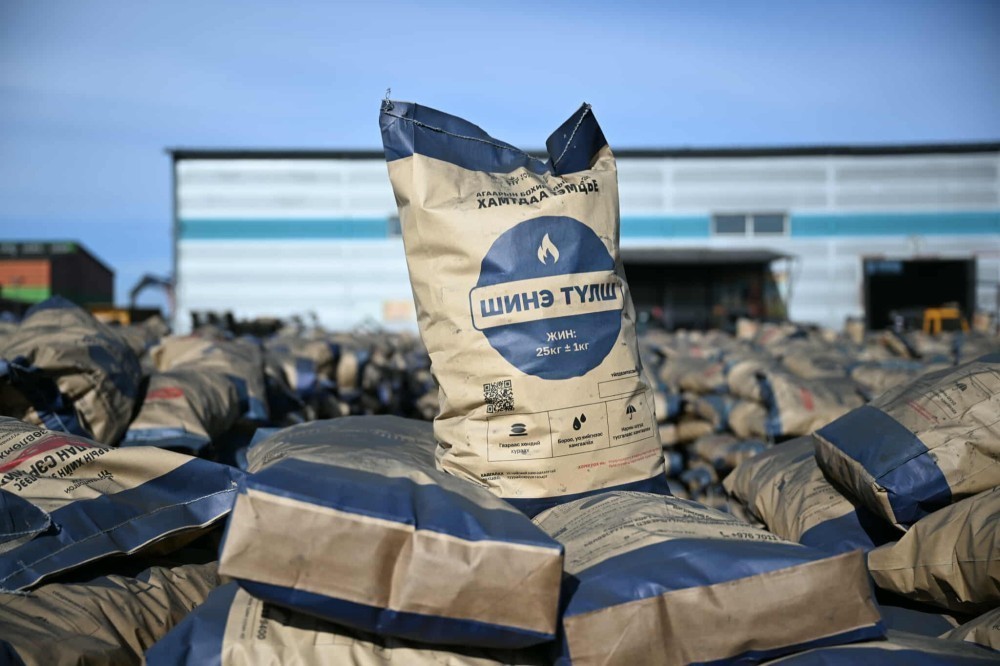
The Scientific Council under the National Committee for Air Pollution Reduction recently convened to evaluate the environmental impact of semi-coke fuel usage among capital residents during the 2025–2026 winter heating season.
During the session, D.Onurbat, a senior air quality specialist at the Meteorological and Environmental Monitoring Department, revealed that key atmospheric pollutants dropped by up to 54% compared to the previous year's winter season.
Official metrics indicate significant reductions across all major monitored pollutants: Sulfur dioxide (SO2): Decreased by 36 µg/m³ (54% reduction). Particulate matter (PM10): Decreased by 23 µg/m³ (21% reduction). Fine particulate matter (PM2.5): Decreased by 9 µg/m³ (17% reduction). Nitrogen dioxide (NO2): Decreased by 2 µg/m³ (4% reduction).
Throughout the 2025–2026 heating season, 436.7 thousand tons of solid fuel were supplied to ger district households across 425 localized distribution points. Semi-coke fuel comprised the vast majority of this supply, totaling 333.3 thousand tons.
The Scientific Council under the National Committee for Air Pollution Reduction recently convened to evaluate the environmental impact of semi-coke fuel usage among capital residents during the 2025–2026 winter heating season.
During the session, D.Onurbat, a senior air quality specialist at the Meteorological and Environmental Monitoring Department, revealed that key atmospheric pollutants dropped by up to 54% compared to the previous year's winter season.
Official metrics indicate significant reductions across all major monitored pollutants: Sulfur dioxide (SO2): Decreased by 36 µg/m³ (54% reduction). Particulate matter (PM10): Decreased by 23 µg/m³ (21% reduction). Fine particulate matter (PM2.5): Decreased by 9 µg/m³ (17% reduction). Nitrogen dioxide (NO2): Decreased by 2 µg/m³ (4% reduction).
Throughout the 2025–2026 heating season, 436.7 thousand tons of solid fuel were supplied to ger district households across 425 localized distribution points. Semi-coke fuel comprised the vast majority of this supply, totaling 333.3 thousand tons.