


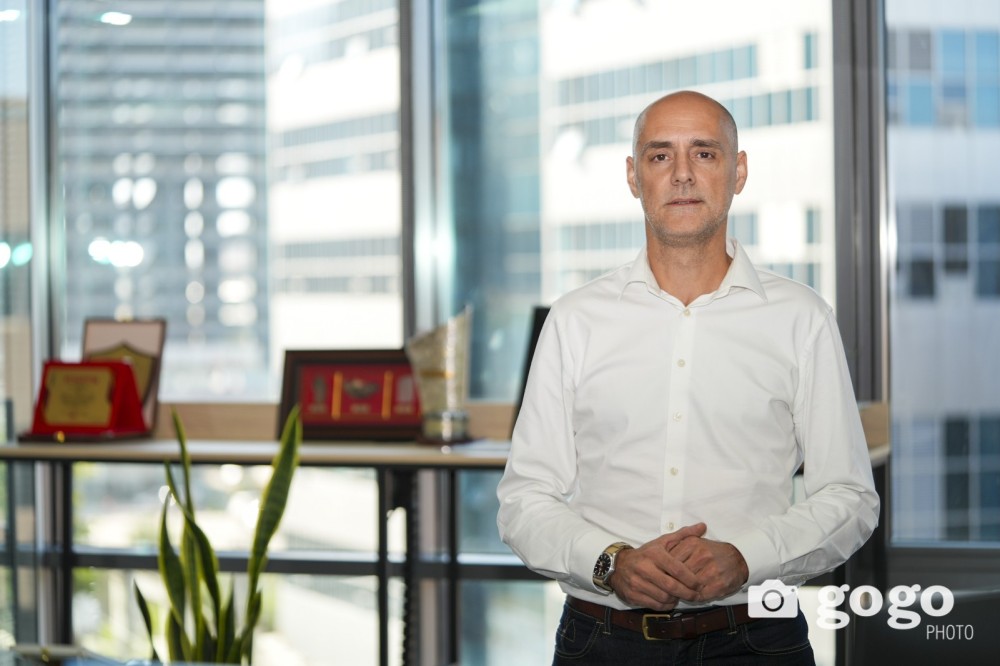
GoGo.mn for this edition of the “Mongolia Through Foreign Eyes” column, we invited Grégoire André (PhD, P.Geo), Geosciences Director at Badrakh Energy LLC, to talk about the company’s operations in Mongolia, the specific nature of work in the geology sector, experiences in training and developing young Mongolian professionals, and the company’s upcoming projects and plans.
You first worked in Mongolia in 2009 and returned in 2025. What was the biggest change you noticed when you came back? What changes have you observed in Mongolia’s mining and geology sectors?
The biggest change was clearly in Ulaanbaatar. I didn't recognize the city itself. The airport was different. I would say Ulaanbaatar, probably more than Mongolia as a whole, has really embraced modernity.
This is a nice sight because you have modern buildings and facilities, and people are talking English everywhere. The young people, of course, but not only them, are very easy to communicate with. That's very important. Most of the taxi drivers I meet know a little bit of English, so that's very practical.
I hope we will make new discoveries because that's in our DNA.
You don't need to carry cash anymore. You can pay for everything digitally. It's crazy. The small anecdote is that on the first day I arrived last year, early in the morning, I saw an ATM at the airport. Because in my memory, there was no ATM in Ulaanbaatar in 2009. So, I rushed to the ATM and took out as much cash as I could. Then, at the first restaurant I went to in Ulaanbaatar, they looked at me because I wanted to pay in cash. It was like, "Who is this guy? He's an alien."
So now I'm paying by card or by telephone like everyone else, but that was a surprise. Of course, Ulaanbaatar is not the same. But when you go outside Ulaanbaatar, many tourist places are very well equipped. Apart from that, I think it is still the Mongolia I knew 15 years ago. There have not been so many changes.
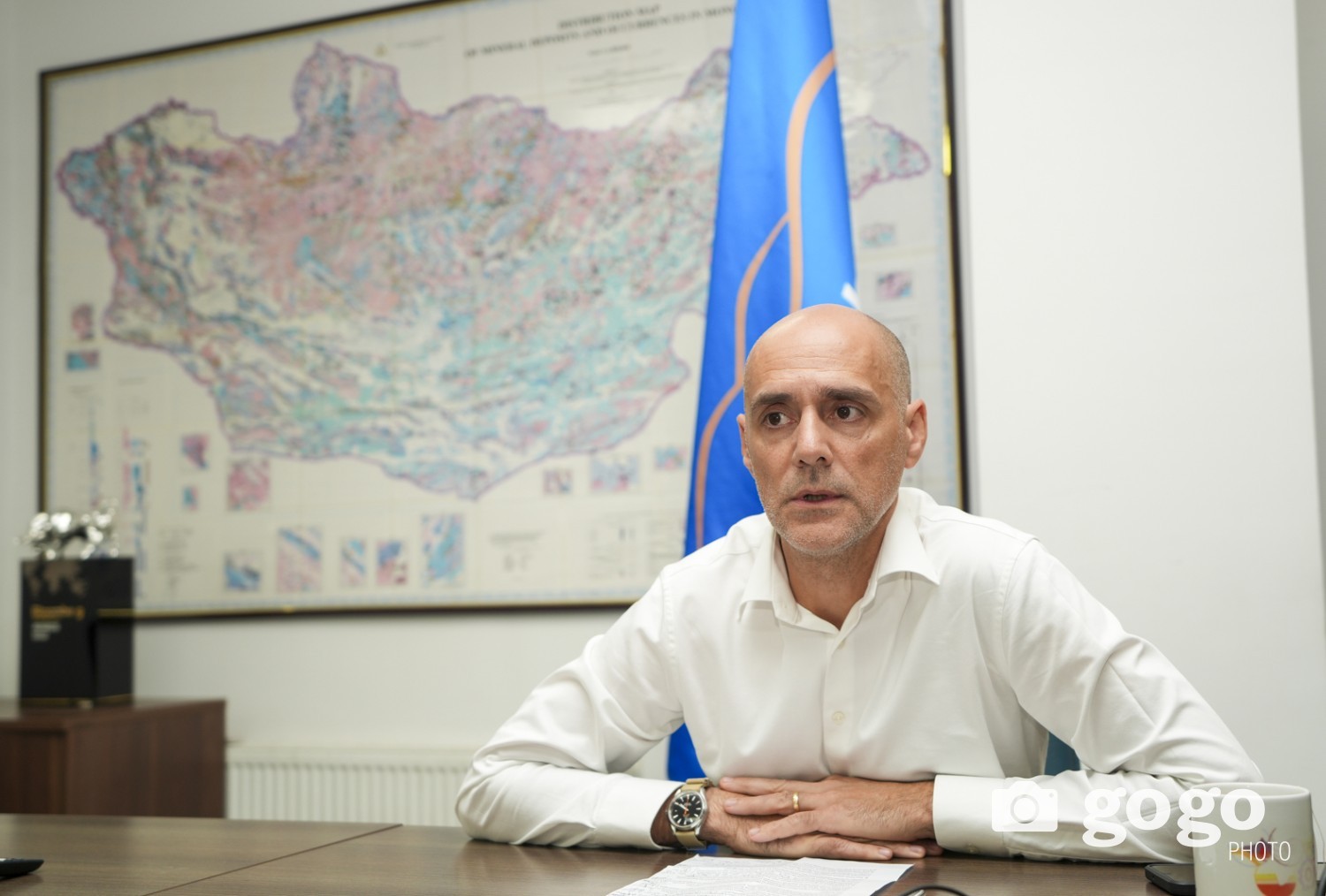
You have worked in uranium exploration and mining in countries including Mongolia, Canada, Australia, Uzbekistan, and Niger. Having worked across these different environments, how would you assess the characteristics and potential of Mongolia’s uranium geology compared with these countries?
Mongolia can be in the top 10 uranium countries in the world, for sure. There is significant geological potential. What is moving now is more about the legal framework for opening up exploration. It is not only uranium; Mongolia also has very high potential for rare earth metals and critical metals. I think the ministry is moving in the right direction to give more value to this potential.
The goal is to change and renew the regulations and provide more opportunities and facilities for exploration and production.
Orano has been conducting uranium exploration in Mongolia since 1997 and discovered the Dulaan Uul and Zuuvch Ovoo deposits. From a geologist’s perspective, what makes these two deposits particularly unique or significant?
There are some resources that have been officially classified at the state level. So, we are not the only ones, but we are the most advanced in terms of starting to mine these deposits.
We start with Dulaan Uul, which is not really unique. It is a very standard roll-front-type deposit. You can find similar deposits in Central Asia, in Kazakhstan and Uzbekistan, and very similar ones in northern China as well. They have the same characteristics. So, that was the first one we discovered, in fact.
And Zuuvch Ovoo is really unique for several reasons. It is clearly a world-class deposit in terms of uranium resources, and its technical parameters are different from those of a classical roll-front deposit. It is very compact.
Generally, a roll-front deposit is an object that is very long, very narrow and very long. It can be 10, 15, 20, or even 30 kilometers long, but only a few hundred meters wide.
Zuuvch Ovoo, on the other hand, is a very large, compact deposit. We call it a potato. It's a big potato. So, it is very singular. It is a unique object. We hope there is more than one like it in Mongolia.
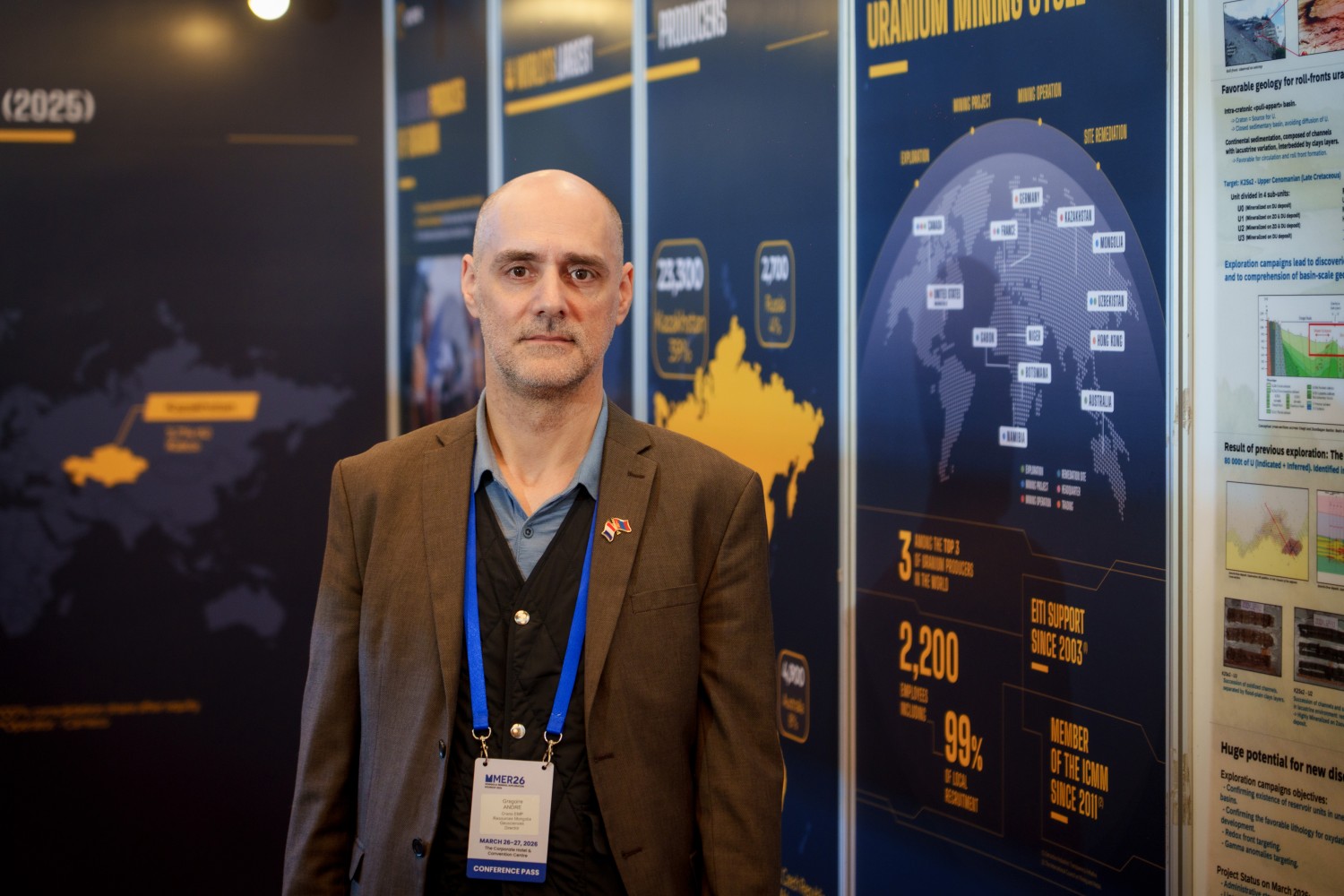
A significant amount of drilling and exploration was carried out to discover these deposits and establish their resources. You mentioned that you led more than 210,000 metres of drilling during your time in Mongolia from 2009 to 2012. What stands out most in your memory from that exploration campaign, and what was one of the biggest challenges you faced?
At that time, the challenge was to drill—to drill with quality and safety. We used to work with several contractors and work very closely with them in a collaborative mode to make sure that we complied with our standards.
At that time, we had a lot of support from our head office and from other subsidiaries to help these Mongolian companies improve their safety and quality to the level we wanted to achieve.
So, that period was a time of learning and collaborative work. At the end of my journey at that time, the results were very good. Two companies had reached a good standard at that time, and I'm very happy that last year we started working with one of them again. They still have the same level of quality and safety. So, I think that was a big change at that time. I note it as a real know how transfer and growing and developing together.
You mentioned safety standards and quality. So I think that means Mongolian professionals have developed by that experience How would you assess the skills and working methods of Mongolian geologists? What strengths do you think they have that allow them to compete at an international level?
Mongolian companies are very agile. They move very fast, and they are very fast learners as well. You show them one, two, three times what the standard is and how you can reach it, and they take it and implement it. Then it becomes the standard. That is the learning curve toward reaching the standard mode.
And if I look at the people I worked with 15 years ago, some of them are now working in uranium in different companies. They are working in gold, and they are working for national agencies.
So, we made some very quick progress. If I compare it with other countries where I spent two, three, or four years, the learning curve was not as efficient.
There is a very strong willingness to progress and to reach the standard as soon as possible. They listen a lot. They don't just do things their own way without listening to your advice. They listen to your advice. They invest a lot. They are ready to invest in terms of people and materials.
So, for me, Mongolia is one of the best countries I have worked in when it comes to the capacity to adapt quickly and with quality.
Fifteen years ago, around the peak of exploration activities, the geosciences team was around 60 to 70 people. When I restarted last year, the geoscience team was maybe five people, spread across different activities.
Since last year, we have rebuilt a full team at Badrakh, with more than 50 people last year and 65 this year. Next year, we will increase the team again. We have had the chance to take back some former employees who gained different professional experiences during the last 10 years.
We also hire new graduates from Mongolian universities, and we hire local young workers from Dornogovi as well. We have 30 percent experienced professionals, 30 percent young people with little experience, and 30 percent very young people with no experience.
This company can achieve more than 90 percent recovery, which is the best value I have ever seen in any of the countries I have worked in for this kind of sediment. So, they have a real level of expertise.
So, that's a very good combination to restart the activity.
And if I look at the people I worked with 15 years ago, some of them are now working in uranium in different companies. They are working in gold, and they are working for national agencies.
So, that means the people who work with us, we train them and increase their level of geological skills. After five, 10, or 15 years, they can move on and contribute to the general ecosystem of specialists in Mongolia.
So, that's very good. We have a team of 60 to 90 people that will contribute to the broader ecosystem of exploration—not only for us, but for the benefit of Mongolia.
And for drilling, I mentioned that one of the companies, OrdGeo, is a company we worked with 20 years ago. We had a few years of collaborative work to increase the quality of their work, and now they deliver the same quality as they did 15 years ago, which is the top standard.
In terms of recovery, when we do exploration, we want to analyze the rocks. The rocks in the area where we drill are sand, so they are very fragile. When you drill through sand, you need a high level of expertise to bring the sample back from 200 meters below the surface.
This company can achieve more than 90 percent recovery, which is the best value I have ever seen in any of the countries I have worked in for this kind of sediment. So, they have a real level of expertise.
There were a few drillers who worked with us 15 years ago, and these experienced drillers are now training young drillers—a new generation—to preserve and transfer this knowledge. So, it is very nice to see that the quality is just improving over time. We don't lose knowledge, and it is even improving with time. It has been a very fruitful collaboration between local private companies and our activities.
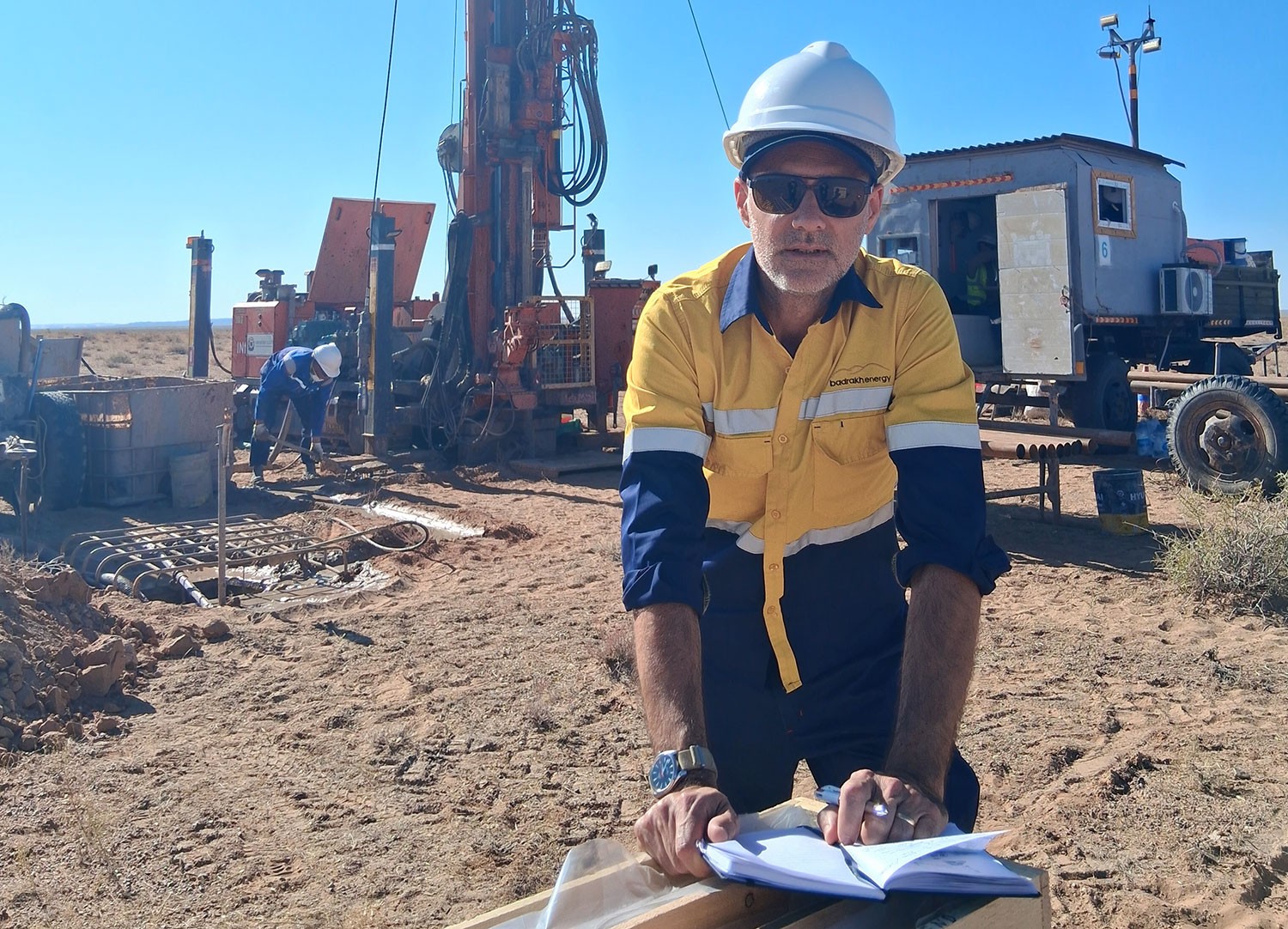
In addition to uranium exploration, you have experience in countries such as Kazakhstan and Uzbekistan in resource estimation and preparing uranium projects for production using in-situ recovery (ISR) technology. How could this experience be applied to the conditions and challenges in Mongolia?
Every country and every deposit is unique, even if you have some parallels and similarities. The technical parameters are similar, but not exactly the same. So, we will have to adjust for sure.
We will compare what works and what doesn't work in other countries, and then we will adjust because the geology is not the same, the climate is not the same, the depth is not the same, and the grade is not the same. So, we must take what works in different places, conduct some tests and make some adjustments to fine-tune the technical parameters.
Every time, it is like starting again, but it is a loop—a loop of progress. You don't start from zero. We start from what we know and from what works in other countries.
Typically, we work a lot with Kazakhstan now. As Kazakhstan is few steps ahead us in successfully conducting ISR mines in the quite same geological and natural conditions. We have many experts from Kazakhstan coming here. They give their advice, we test, we adjust, and we make it work in the Mongolian way.
So, we must take what works in other countries but adjust it to the Mongolian characteristics—in terms of geology, technical parameters, skills, and people. It's like every time it is the same, but different.
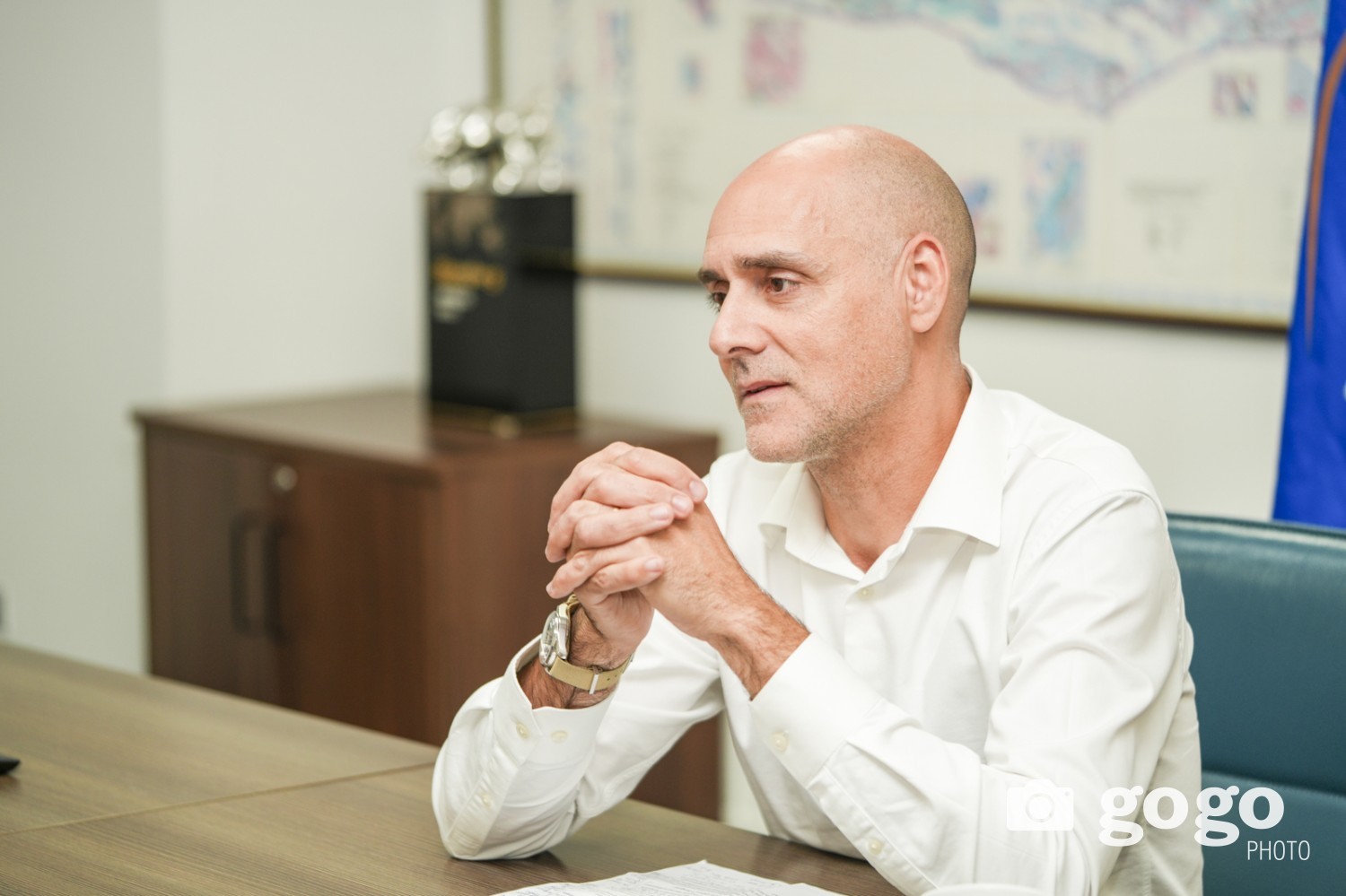
Looking ahead, what potential do you see for making new discoveries in Mongolia’s uranium sector?
Mongolia has very high potential. I hope we will make new discoveries because that's in our DNA. We are explorers in uranium.
Most of the uranium deposits that are being mined were discovered by uranium exploration professionals. So, we are not only miners; we are also geologists and exploration geologists.
We discovered Dulaan Uul and Zuuvch Ovoo 15 to 20 years ago. Now, we expect to discover the next big one in Mongolia, for sure.
You have spent more than 20 years working in the mining industry across different countries and environments. What do you enjoy most about working in Mongolia? And as a foreign professional, what has been the most challenging thing for you to adapt to here?
The biggest challenge is every winter. Clearly, winter is very hard, especially when you work in the field. In the past, we used to stop all operations for the big winter, around mid-November, and resume in March or April.
We spent the winter in Ulaanbaatar, and people took their leave. For geologists, they could prepare reports and plan the next campaign.
The local community around the project knows us. We have a lot of meetings with them, they work for us, and they work with us.
But now, for mining, we will have to adapt to winter because a mine will never stop. When you start a mine, you run the mine for 30 years.
So, you have to work from January 1 to December 31 and restart the day after. For me, the biggest challenge is being able to adapt from what was previously a seasonal work mode to a full-year work mode.
So, for me, this is a big challenge, for sure. And how we will make it work—that's what I said before. Mongolian colleagues are very good at adapting. They are very agile.
So, we will find solutions together, implement them, improve them, and succeed in putting this new mode of operation into practice. I'm very optimistic that we will find the right way to work through the winter.
There is sometimes opposition from local communities due to a lack of information. In your view, what can companies do, together with the Mongolian government and local communities, to address this issue?
I have quite a different view on that. For example, when I was looking for an apartment last year, I visited a few apartments and met a few owners. They always asked me, "What are you doing? Which company do you work for?"
Were they local people?
They were Mongolian people in Ulaanbaatar. They all knew the company, they all knew about uranium, and they were all favorable because they saw this as progress, as modernity, as embracing the future.
So, I was very impressed because people knew us and had a favorable approach toward us. And now, when you look at Dornogovi, where we work and where we have all our activities, my team is 95 percent Mongolian, and we also have many workers from Dornogovi. These workers have been working with us from the beginning.
We have a few positions that we renew every year, so we see mostly young people, and they are very happy to work with us. Generally, they come for a few years, and then they go back to school or pursue further studies.
The local community around the project knows us. We have a lot of meetings with them, they work for us, and they work with us.
So, for me, the train is moving, and nobody can stop it. And everybody is on the train; nobody will stay at the station. I'm quite positive about the change from 20 years ago, when the activity was small and people didn't know what we were doing.
Now, my feeling is that in Ulaanbaatar, people know us, and in Sainshand, they know us as well. They see us as progress and modernity, bringing employment, energy, and transportation infrastructure to the project. So, I'm very optimistic about how we can work together.
What are your thoughts on Mongolia's current legal and policy environment for foreign investors? How do the laws and the political climate affect the way foreign companies operate in the country?
The project had a big milestone last year with the investment agreement, which is a completely new design for the investment agreement.
It considers how much Mongolia will gain from this project. The objective is to have Mongolia as a partner, and for Mongolia as a state, as well as the communities around the project, to benefit from it. So, this has been addressed for a long time, and now it is reflected in the signed investment agreement, which covers this topic.
I understand that you are interested in obtaining a new exploration license. Could you provide us with more details about this?
Orano, which is the French investor in the Zuuvch Ovoo project, is very interested in making sure that the Zuuvch Ovoo project is only the first stone and that we can find more uranium to extend the lifetime of the mine.
We expect that we will be ready next spring to prepare all the work for next year's exploration.
A mine is a big investment. You have to train people, secure infrastructure, power, roads, and so on. So, if Zuuvch Ovoo, which is a 30-year-life project, doesn't have any more resources, after 30 years, it's the end.
For the benefit of both the company and Mongolia, we would like to find more uranium to make sure that we can continue our activities and operations after 30 years. That's why we are very involved in restarting exploration, as we did 30 years ago.
We have a subsidiary that specializes in exploration, and we work with MRPAM—the Mineral Resources and Petroleum Authority of Mongolia—and with the Ministry of Industry and Mineral Resources to secure some new exploration licenses. We are preparing for some new exploration next year. We have already submitted an application to MRPAM for a new exploration license in Dornogovi.
We expect that we will be ready next spring to prepare all the work for next year's exploration. I'm very optimistic that next year we could have new licenses to start some new exploration work and secure the long-term future of Zuuvch Ovoo. So, I hope that next year we will be back like 20 or 30 years ago, as pioneers in exploration.
Could you explain how your company approaches land rehabilitation and environmental restoration?
The footprint of drilling is very small, and a drilling rig is smaller than a truck. The size of the drill hole is a little more than 10 centimeters in diameter.
I thought it was so huge.
No, the drill hole is very small; the diameter is very small. When we take the sample, we then fill the well with cement to make sure that there is no circulation between the different levels of water and that it is clean. After that, you simply remove any cement that has spread around, and then you put the soil back as it was. Generally, you take the topsoil, if there is any on the site, and put it back. After one year, you can't even tell that there was drilling here. It's very light.
Thank you for your time.
GoGo.mn for this edition of the “Mongolia Through Foreign Eyes” column, we invited Grégoire André (PhD, P.Geo), Geosciences Director at Badrakh Energy LLC, to talk about the company’s operations in Mongolia, the specific nature of work in the geology sector, experiences in training and developing young Mongolian professionals, and the company’s upcoming projects and plans.
You first worked in Mongolia in 2009 and returned in 2025. What was the biggest change you noticed when you came back? What changes have you observed in Mongolia’s mining and geology sectors?
The biggest change was clearly in Ulaanbaatar. I didn't recognize the city itself. The airport was different. I would say Ulaanbaatar, probably more than Mongolia as a whole, has really embraced modernity.
This is a nice sight because you have modern buildings and facilities, and people are talking English everywhere. The young people, of course, but not only them, are very easy to communicate with. That's very important. Most of the taxi drivers I meet know a little bit of English, so that's very practical.
I hope we will make new discoveries because that's in our DNA.
You don't need to carry cash anymore. You can pay for everything digitally. It's crazy. The small anecdote is that on the first day I arrived last year, early in the morning, I saw an ATM at the airport. Because in my memory, there was no ATM in Ulaanbaatar in 2009. So, I rushed to the ATM and took out as much cash as I could. Then, at the first restaurant I went to in Ulaanbaatar, they looked at me because I wanted to pay in cash. It was like, "Who is this guy? He's an alien."
So now I'm paying by card or by telephone like everyone else, but that was a surprise. Of course, Ulaanbaatar is not the same. But when you go outside Ulaanbaatar, many tourist places are very well equipped. Apart from that, I think it is still the Mongolia I knew 15 years ago. There have not been so many changes.
You have worked in uranium exploration and mining in countries including Mongolia, Canada, Australia, Uzbekistan, and Niger. Having worked across these different environments, how would you assess the characteristics and potential of Mongolia’s uranium geology compared with these countries?
Mongolia can be in the top 10 uranium countries in the world, for sure. There is significant geological potential. What is moving now is more about the legal framework for opening up exploration. It is not only uranium; Mongolia also has very high potential for rare earth metals and critical metals. I think the ministry is moving in the right direction to give more value to this potential.
The goal is to change and renew the regulations and provide more opportunities and facilities for exploration and production.
Orano has been conducting uranium exploration in Mongolia since 1997 and discovered the Dulaan Uul and Zuuvch Ovoo deposits. From a geologist’s perspective, what makes these two deposits particularly unique or significant?
There are some resources that have been officially classified at the state level. So, we are not the only ones, but we are the most advanced in terms of starting to mine these deposits.
We start with Dulaan Uul, which is not really unique. It is a very standard roll-front-type deposit. You can find similar deposits in Central Asia, in Kazakhstan and Uzbekistan, and very similar ones in northern China as well. They have the same characteristics. So, that was the first one we discovered, in fact.
And Zuuvch Ovoo is really unique for several reasons. It is clearly a world-class deposit in terms of uranium resources, and its technical parameters are different from those of a classical roll-front deposit. It is very compact.
Generally, a roll-front deposit is an object that is very long, very narrow and very long. It can be 10, 15, 20, or even 30 kilometers long, but only a few hundred meters wide.
Zuuvch Ovoo, on the other hand, is a very large, compact deposit. We call it a potato. It's a big potato. So, it is very singular. It is a unique object. We hope there is more than one like it in Mongolia.
A significant amount of drilling and exploration was carried out to discover these deposits and establish their resources. You mentioned that you led more than 210,000 metres of drilling during your time in Mongolia from 2009 to 2012. What stands out most in your memory from that exploration campaign, and what was one of the biggest challenges you faced?
At that time, the challenge was to drill—to drill with quality and safety. We used to work with several contractors and work very closely with them in a collaborative mode to make sure that we complied with our standards.
At that time, we had a lot of support from our head office and from other subsidiaries to help these Mongolian companies improve their safety and quality to the level we wanted to achieve.
So, that period was a time of learning and collaborative work. At the end of my journey at that time, the results were very good. Two companies had reached a good standard at that time, and I'm very happy that last year we started working with one of them again. They still have the same level of quality and safety. So, I think that was a big change at that time. I note it as a real know how transfer and growing and developing together.
You mentioned safety standards and quality. So I think that means Mongolian professionals have developed by that experience How would you assess the skills and working methods of Mongolian geologists? What strengths do you think they have that allow them to compete at an international level?
Mongolian companies are very agile. They move very fast, and they are very fast learners as well. You show them one, two, three times what the standard is and how you can reach it, and they take it and implement it. Then it becomes the standard. That is the learning curve toward reaching the standard mode.
And if I look at the people I worked with 15 years ago, some of them are now working in uranium in different companies. They are working in gold, and they are working for national agencies.
So, we made some very quick progress. If I compare it with other countries where I spent two, three, or four years, the learning curve was not as efficient.
There is a very strong willingness to progress and to reach the standard as soon as possible. They listen a lot. They don't just do things their own way without listening to your advice. They listen to your advice. They invest a lot. They are ready to invest in terms of people and materials.
So, for me, Mongolia is one of the best countries I have worked in when it comes to the capacity to adapt quickly and with quality.
Fifteen years ago, around the peak of exploration activities, the geosciences team was around 60 to 70 people. When I restarted last year, the geoscience team was maybe five people, spread across different activities.
Since last year, we have rebuilt a full team at Badrakh, with more than 50 people last year and 65 this year. Next year, we will increase the team again. We have had the chance to take back some former employees who gained different professional experiences during the last 10 years.
We also hire new graduates from Mongolian universities, and we hire local young workers from Dornogovi as well. We have 30 percent experienced professionals, 30 percent young people with little experience, and 30 percent very young people with no experience.
This company can achieve more than 90 percent recovery, which is the best value I have ever seen in any of the countries I have worked in for this kind of sediment. So, they have a real level of expertise.
So, that's a very good combination to restart the activity.
And if I look at the people I worked with 15 years ago, some of them are now working in uranium in different companies. They are working in gold, and they are working for national agencies.
So, that means the people who work with us, we train them and increase their level of geological skills. After five, 10, or 15 years, they can move on and contribute to the general ecosystem of specialists in Mongolia.
So, that's very good. We have a team of 60 to 90 people that will contribute to the broader ecosystem of exploration—not only for us, but for the benefit of Mongolia.
And for drilling, I mentioned that one of the companies, OrdGeo, is a company we worked with 20 years ago. We had a few years of collaborative work to increase the quality of their work, and now they deliver the same quality as they did 15 years ago, which is the top standard.
In terms of recovery, when we do exploration, we want to analyze the rocks. The rocks in the area where we drill are sand, so they are very fragile. When you drill through sand, you need a high level of expertise to bring the sample back from 200 meters below the surface.
This company can achieve more than 90 percent recovery, which is the best value I have ever seen in any of the countries I have worked in for this kind of sediment. So, they have a real level of expertise.
There were a few drillers who worked with us 15 years ago, and these experienced drillers are now training young drillers—a new generation—to preserve and transfer this knowledge. So, it is very nice to see that the quality is just improving over time. We don't lose knowledge, and it is even improving with time. It has been a very fruitful collaboration between local private companies and our activities.
In addition to uranium exploration, you have experience in countries such as Kazakhstan and Uzbekistan in resource estimation and preparing uranium projects for production using in-situ recovery (ISR) technology. How could this experience be applied to the conditions and challenges in Mongolia?
Every country and every deposit is unique, even if you have some parallels and similarities. The technical parameters are similar, but not exactly the same. So, we will have to adjust for sure.
We will compare what works and what doesn't work in other countries, and then we will adjust because the geology is not the same, the climate is not the same, the depth is not the same, and the grade is not the same. So, we must take what works in different places, conduct some tests and make some adjustments to fine-tune the technical parameters.
Every time, it is like starting again, but it is a loop—a loop of progress. You don't start from zero. We start from what we know and from what works in other countries.
Typically, we work a lot with Kazakhstan now. As Kazakhstan is few steps ahead us in successfully conducting ISR mines in the quite same geological and natural conditions. We have many experts from Kazakhstan coming here. They give their advice, we test, we adjust, and we make it work in the Mongolian way.
So, we must take what works in other countries but adjust it to the Mongolian characteristics—in terms of geology, technical parameters, skills, and people. It's like every time it is the same, but different.
Looking ahead, what potential do you see for making new discoveries in Mongolia’s uranium sector?
Mongolia has very high potential. I hope we will make new discoveries because that's in our DNA. We are explorers in uranium.
Most of the uranium deposits that are being mined were discovered by uranium exploration professionals. So, we are not only miners; we are also geologists and exploration geologists.
We discovered Dulaan Uul and Zuuvch Ovoo 15 to 20 years ago. Now, we expect to discover the next big one in Mongolia, for sure.
You have spent more than 20 years working in the mining industry across different countries and environments. What do you enjoy most about working in Mongolia? And as a foreign professional, what has been the most challenging thing for you to adapt to here?
The biggest challenge is every winter. Clearly, winter is very hard, especially when you work in the field. In the past, we used to stop all operations for the big winter, around mid-November, and resume in March or April.
We spent the winter in Ulaanbaatar, and people took their leave. For geologists, they could prepare reports and plan the next campaign.
The local community around the project knows us. We have a lot of meetings with them, they work for us, and they work with us.
But now, for mining, we will have to adapt to winter because a mine will never stop. When you start a mine, you run the mine for 30 years.
So, you have to work from January 1 to December 31 and restart the day after. For me, the biggest challenge is being able to adapt from what was previously a seasonal work mode to a full-year work mode.
So, for me, this is a big challenge, for sure. And how we will make it work—that's what I said before. Mongolian colleagues are very good at adapting. They are very agile.
So, we will find solutions together, implement them, improve them, and succeed in putting this new mode of operation into practice. I'm very optimistic that we will find the right way to work through the winter.
There is sometimes opposition from local communities due to a lack of information. In your view, what can companies do, together with the Mongolian government and local communities, to address this issue?
I have quite a different view on that. For example, when I was looking for an apartment last year, I visited a few apartments and met a few owners. They always asked me, "What are you doing? Which company do you work for?"
Were they local people?
They were Mongolian people in Ulaanbaatar. They all knew the company, they all knew about uranium, and they were all favorable because they saw this as progress, as modernity, as embracing the future.
So, I was very impressed because people knew us and had a favorable approach toward us. And now, when you look at Dornogovi, where we work and where we have all our activities, my team is 95 percent Mongolian, and we also have many workers from Dornogovi. These workers have been working with us from the beginning.
We have a few positions that we renew every year, so we see mostly young people, and they are very happy to work with us. Generally, they come for a few years, and then they go back to school or pursue further studies.
The local community around the project knows us. We have a lot of meetings with them, they work for us, and they work with us.
So, for me, the train is moving, and nobody can stop it. And everybody is on the train; nobody will stay at the station. I'm quite positive about the change from 20 years ago, when the activity was small and people didn't know what we were doing.
Now, my feeling is that in Ulaanbaatar, people know us, and in Sainshand, they know us as well. They see us as progress and modernity, bringing employment, energy, and transportation infrastructure to the project. So, I'm very optimistic about how we can work together.
What are your thoughts on Mongolia's current legal and policy environment for foreign investors? How do the laws and the political climate affect the way foreign companies operate in the country?
The project had a big milestone last year with the investment agreement, which is a completely new design for the investment agreement.
It considers how much Mongolia will gain from this project. The objective is to have Mongolia as a partner, and for Mongolia as a state, as well as the communities around the project, to benefit from it. So, this has been addressed for a long time, and now it is reflected in the signed investment agreement, which covers this topic.
I understand that you are interested in obtaining a new exploration license. Could you provide us with more details about this?
Orano, which is the French investor in the Zuuvch Ovoo project, is very interested in making sure that the Zuuvch Ovoo project is only the first stone and that we can find more uranium to extend the lifetime of the mine.
We expect that we will be ready next spring to prepare all the work for next year's exploration.
A mine is a big investment. You have to train people, secure infrastructure, power, roads, and so on. So, if Zuuvch Ovoo, which is a 30-year-life project, doesn't have any more resources, after 30 years, it's the end.
For the benefit of both the company and Mongolia, we would like to find more uranium to make sure that we can continue our activities and operations after 30 years. That's why we are very involved in restarting exploration, as we did 30 years ago.
We have a subsidiary that specializes in exploration, and we work with MRPAM—the Mineral Resources and Petroleum Authority of Mongolia—and with the Ministry of Industry and Mineral Resources to secure some new exploration licenses. We are preparing for some new exploration next year. We have already submitted an application to MRPAM for a new exploration license in Dornogovi.
We expect that we will be ready next spring to prepare all the work for next year's exploration. I'm very optimistic that next year we could have new licenses to start some new exploration work and secure the long-term future of Zuuvch Ovoo. So, I hope that next year we will be back like 20 or 30 years ago, as pioneers in exploration.
Could you explain how your company approaches land rehabilitation and environmental restoration?
The footprint of drilling is very small, and a drilling rig is smaller than a truck. The size of the drill hole is a little more than 10 centimeters in diameter.
I thought it was so huge.
No, the drill hole is very small; the diameter is very small. When we take the sample, we then fill the well with cement to make sure that there is no circulation between the different levels of water and that it is clean. After that, you simply remove any cement that has spread around, and then you put the soil back as it was. Generally, you take the topsoil, if there is any on the site, and put it back. After one year, you can't even tell that there was drilling here. It's very light.
Thank you for your time.